
Even though he’s the president of the largest liquor store chain in Alaska, Bruce Abbott still finds time to host wine and spirits dinners organized by his stores. “I got into this industry because I love sharing product knowledge with people and the events allow me to continue to connect with customers,” he says. The hosting duties also ensure that “my job isn’t just about spreadsheets and inventory,” he adds. “This is a business about product and people.”
Indeed, Abbott, president of Liquor Stores USA North (dba Brown Jug) is a beverage alcohol retailer with a passion for the products he sells and the customers he serves. A Fairbanks, Alaska native, he’s worked in all tiers of the beverage alcohol industry, starting his career as a waiter and immediately “catching the wine bug,” he says. “I loved the ability to share my wine knowledge with customers.”
In 2011, Abbott, after stints at a craft brewpub and a distributor, ventured into beverage alcohol retailing, opening a boutique wine shop in Fairbanks with a partner. But in 2013, he was recruited by Brown Jug to manage its new store in the interior Alaskan city. With recognition from the Society of Wine Educators as both a Certified Specialist of Wine and a Certified Specialist of Spirits, Abbott was soon named wine buyer for the chain. Before long, he added spirits to his responsibilities, and early last year, Abbott was named president.
For his accomplishments in retailing and commitment to educating consumers about all beverage alcohol products, Bruce Abbott has been named a 2025 Market Watch Leader.
Broad-Spectrum Focus
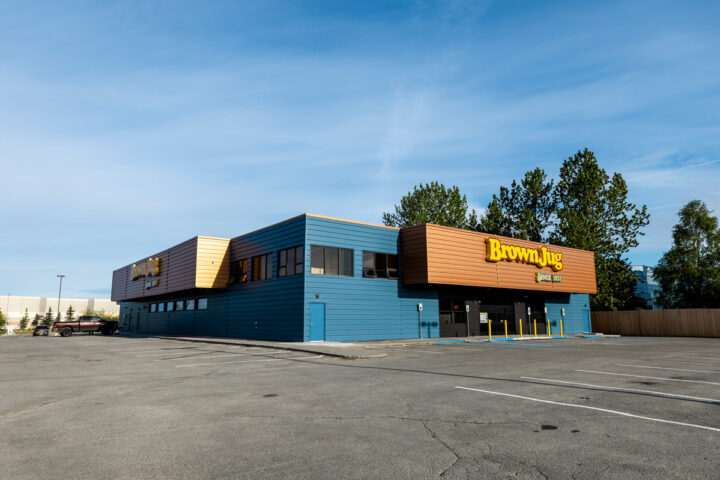
With 24 stores and the ability to sell product statewide, Brown Jug is estimated to have annual sales approaching $100 million. Brown Jug’s roots date back to 1937 with the establishment of a tavern and roadhouse business in Anchorage by Harry O’Neill. His son Michael opened the first Brown Jug in 1955, and over the course of the next five decades, new locations were added, with expansion into Wasilla, Eagle River, and Fairbanks. In 2008, the business was sold to a Canadian retailer, and 12 years later, Brown Jug was acquired by Afognak Commercial Group, LLC, a subsidiary of Afognak Native Corp. In his role today, Abbott reports to Ana Fisk, president of Afognak Commercial Group.
Nineteen Brown Jug stores are located in the Anchorage area, three are in Wasilla, one store is in Eagle River, and one is in Fairbanks. Due to the disparity in markets, customer demographics vary, and as a result, product selection and emphasis don’t conform store to store. “We service a broad spectrum of folks in Alaska,” Abbott says. “We cater to each neighborhood.” Brown Jug stores range in size from 1,400 to 25,000 square feet, and with most of the locations leased, “no two stores share the same floor plan,” the retailer notes. But the unique configuration of each location gives the company the “flexibility to adjust the selection appropriately,” he adds.
Some 220 workers are employed at Brown Jug, and, not surprisingly, Abbott encourages them to educate themselves about the products they sell. The chain’s category managers across wine, spirits, beer, and cigars lead weekly classes, which new employees are required to attend so that within a few months they have a basic knowledge of the categories. Employees can also receive performance rewards and raises for various industry certifications. “I’ve always felt that customer service and sales are two sides of the same coin,” Abbott says. “If we can perfect the customer service experience, we’ll see the growth in sales.”
Spirits Are King
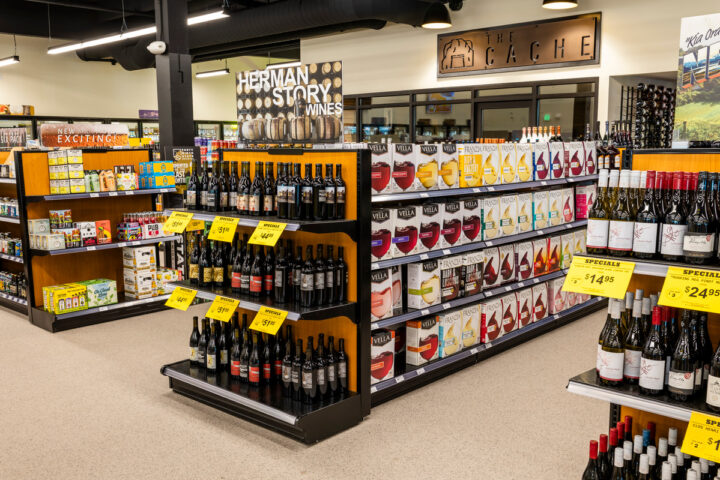
Distilled spirits account for 45% of Brown Jug’s sales, followed by beer at 25%, wine at 20%, and miscellaneous items, including cigars, at 10%. “In Alaska, spirits are king,” says Abbott. As a result, the chain stocks some 3,500 spirits SKUs, priced from $11 for a 750-ml. of Monarch vodka to $9,000 for Balvenie 40-year-old Scotch. Top-selling brands include Smirnoff vodka ($17), Tito’s vodka ($23), Crown Royal Canadian whisky ($30), and Jameson Irish whiskey ($30).
“The Bourbon boom born of the pandemic has slowed, if not ended,” the retailer says. While sales of well-aged products from “traditional distilleries” are strong and demand remains high for allocated products and limited releases, “newer distilleries that don’t have aged products and brands that rely on sourced whiskey are having trouble in this market right now,” Abbott notes. As with other retailers, Brown Jug is scaling back on single barrels as demand wanes. “We’re finding that we have to be more selective of the barrels than we have in the past,” he says. “We’re looking for brands that have a hype and interest in the whisk(e)y community.” The chain sometimes partners with distilleries on short or half barrels, “which makes it a little more palatable to sell through,” Abbott adds.
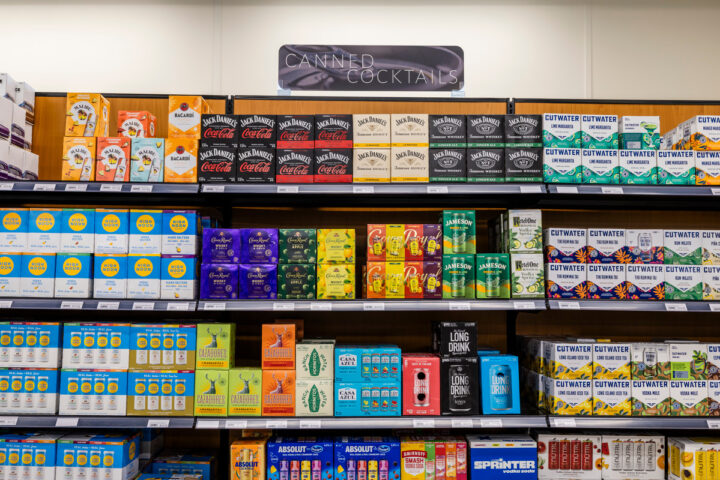
RTDs are another proliferating category that the spirits team at Brown Jug monitors. “The first movers are the winners,” Abbott says of brands like High Noon ($24 an 8-pack of 12-ounce cans) and Cutwater ($30 a 12-pack), “while copycat brands are struggling or exiting the market.” Locally produced RTDs are also performing well at the chain, the retailer notes, pointing to brands like Denali Spirits’ Blueberry Mojito ($18 a 4-pack). “They’re competing head-to-head with national brands and a lot of times beating them,” the retailer says.
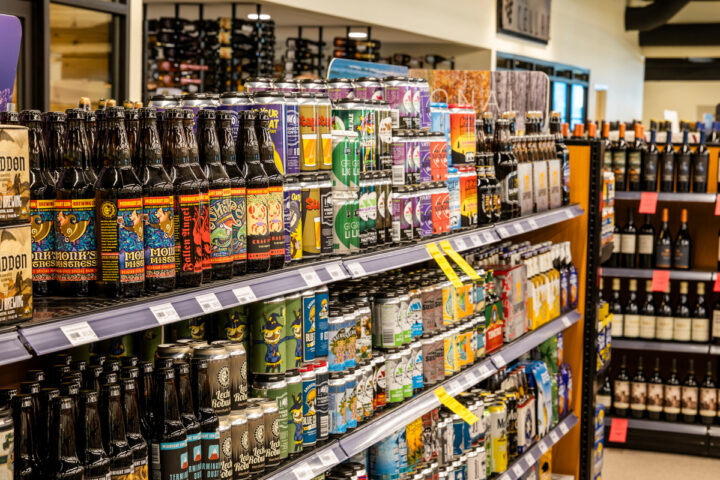
Brown Jug offers about 1,600 beer SKUs, priced from $11 for a 6-pack of 12-ounce cans of Miller High Life to $40 a 4-pack of 12-ounce bottles of Dogfish Head Wakeup Worldwide stout. Top-selling brands include Coors Light ($34 a 30-pack of 12-ounce cans) and Corona Extra ($28 an 18-pack). “Domestic beers have taken it on the chin,” Abbott notes, “and Mexican imports are very strong.” He adds that the Alaska market “still has a very strong local craft beer scene and many craft lovers come to Brown Jug for those beers.” Indeed, King Street IPA ($23 a 12-pack) from Anchorage’s King Street Brewing is the No. 4 SKU at the chain. Brown Jug stores feature between six and 30 cooler doors, depending on the location.
Wine On The Upswing
Abbott concedes that the wine category was “challenging” for the chain last year, but he’s thrilled that through May of 2025, sales were up. “We’re trying to match selection to what customers are looking for,” he explains, and that is “less imports and more domestic wines.” The retailer laments that the wine business has done a poor job in introducing millennial and Gen Z consumers to classic Old World wines. “They’ve been gate kept by price and pretension,” he believes. “The industry needs to make the category approachable for these consumers.” Brown Jug stocks about 3,000 wine SKUs, priced from $7 for a 750-ml. bottle of Redwood Highway Chardonnay to $2,249 for the 2016 Château Haut-Brion. Top selling brands include Kendall-Jackson Vintners Reserve Chardonnay ($16), Veuve Clicquot Yellow Label Brut ($78), and Bota Box ($20 a 3-liter box). Boxed wine accounts for about 25% of the Alaskan wine market, Abbott notes.
While Brown Jug doesn’t have an e-commerce presence, per se, the chain has recently launched an e-commerce platform for rural orders—sales to consumers in remote areas of Alaska, including villages that aren’t on a road system and where there are no liquor stores. Once an order is successfully placed, it’s shipped via prop planes to common carriers authorized by Alaska’s Alcohol & Marijuana Control Office, which arrange for the last leg of delivery. Abbott believes Brown Jug’s new e-commerce platform, which allows for the uploading of customer IDs and signatures, versus previous written orders, is the only one of its kind in the state.
Another recent development for the chain and for other liquor store operators in the state is the ability to host in-store sampling. While legislation recently enacted stipulates that retailers must pour the product and that it must come from the store’s inventory, Abbott says, “the advantage is that we can chose the products we want to expose our customers to.” Among other in-store events promoted by Brown Jug is its Weekends of Whiskey special release series that often find customers camped out overnight to be among the first to gain admittance. Despite the slowdown in Bourbon sales, “we still have a core of people who love the chase,” Abbott says. Off-site dinners at local restaurants, meanwhile, which can range from $35 to $250 a ticket, are also frequently hosted by the chain.
Community Minded
To reach its far-flung customer base, Brown Jug utilizes radio and print advertising, including direct mailers. But increasingly, “email is becoming our most impactful tool,” the retailer notes. “We have an email database of well over 30,000 subscribers. For Alaska, that’s a big number.” Abbott adds that the emails have an impressive open rate because “we’re sending people information that they’re interested in.” As a result, events often sell out in a matter of hours.
The chain is also a big supporter of community groups. Noting that Brown Jug’s tagline is “Locally Owned and Community Minded,” Abbott says that among the organizations to which the chain contributes are the Alaska chapter of the American Cancer Society and the Healthy Alaska Natives Foundation, as well as fundraising for the Food Bank of Alaska.
There are no plans for new Brown Jug locations at this point, Abbott says. Rather, “we’re always looking at renovating our aging locations to bring them up to our newer elevated standards.” The company’s largest store, the Brown Jug Warehouse in Anchorage, was renovated earlier this year. Instead of a focus on more stores, the retailer says, “the emphasis will be on dialing in on the in-store experience at the stores we have.”
Bringing Brown Jug customers an elevated experience is certainly in Abbott’s wheelhouse. “The Brown Jug brand got its start in 1937,” the retailer says. “To be a steward for this 88-year-old iconic Alaskan brand, and to bring it into the future, is exciting for me, and I’m honored to do it.”
Even though he’s the president of the largest liquor store chain in Alaska, Bruce Abbott still finds time to host wine and spirits dinners organized by his stores. “I got into this industry because I love sharing product knowledge with people and the events allow me to continue to connect with customers,” he says. The hosting duties also ensure that “my job isn’t just about spreadsheets and inventory,” he adds. “This is a business about product and people.”
Indeed, Abbott, president of Liquor Stores USA North (dba Brown Jug) is a beverage alcohol retailer with a passion for the products he sells and the customers he serves. A Fairbanks, Alaska native, he’s worked in all tiers of the beverage alcohol industry, starting his career as a waiter and immediately “catching the wine bug,” he says. “I loved the ability to share my wine knowledge with customers.”
In 2011, Abbott, after stints at a craft brewpub and a distributor, ventured into beverage alcohol retailing, opening a boutique wine shop in Fairbanks with a partner. But in 2013, he was recruited by Brown Jug to manage its new store in the interior Alaskan city. With recognition from the Society of Wine Educators as both a Certified Specialist of Wine and a Certified Specialist of Spirits, Abbott was soon named wine buyer for the chain. Before long, he added spirits to his responsibilities, and early last year, Abbott was named president.
For his accomplishments in retailing and commitment to educating consumers about all beverage alcohol products, Bruce Abbott has been named a 2025 Market Watch Leader.
Broad-Spectrum Focus
With 24 stores and the ability to sell product statewide, Brown Jug is estimated to have annual sales approaching $100 million. Brown Jug’s roots date back to 1937 with the establishment of a tavern and roadhouse business in Anchorage by Harry O’Neill. His son Michael opened the first Brown Jug in 1955, and over the course of the next five decades, new locations were added, with expansion into Wasilla, Eagle River, and Fairbanks. In 2008, the business was sold to a Canadian retailer, and 12 years later, Brown Jug was acquired by Afognak Commercial Group, LLC, a subsidiary of Afognak Native Corp. In his role today, Abbott reports to Ana Fisk, president of Afognak Commercial Group.