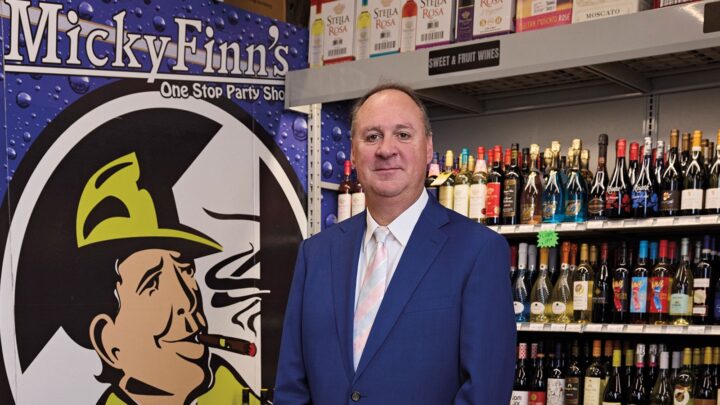
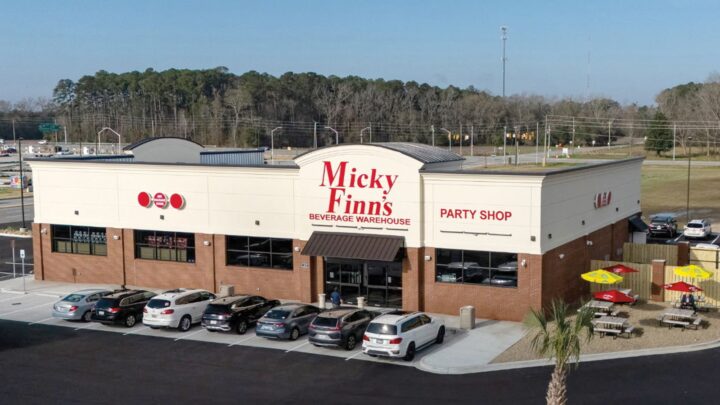
Long interested in adding a third location to his South Carolina liquor store business, Rick Havekost immediately knew he had found what he was looking for when he first eyed a two-acre parcel just off Interstate 95 a few years ago. Not only was the property at Exit 170 in Florence, South Carolina ideally situated to attract locals and tourists heading to and from the beach, but it was also right across the street from the hottest retail concept in the area—perhaps even the country—the mammoth convenience store Buc-ee’s.
Now nearly two years after opening the third Micky Finn’s store, owner Havekost says it’s likely more units will be added near other locations of Buc-ee’s—the c-store mega retailer known for its many fuel pumps, spotless restrooms, and humorous billboards. “The odds are better than 50-50” that Micky Finn’s will expand further west and south as Buc-ee’s seeks to build additional South Carolina stores, Havekost says. Already, he’s witnessed the rub-off effect that comes with neighboring a retail sensation. While the area around the Florence Buc-ee’s is still being developed, “I see that Micky Finn’s location soon being my highest volume store,” notes Havekost, pointing to high traffic and high rings from visitors from other states, such as North Carolina, where spirits prices are generally higher. It’s not unusual, therefore, for those customers to purchase Tito’s Handmade vodka ($32 a 1.75-liter) by the case, he explains.
With sales revenue of about $30 million (excluding some $20 million in wholesale sales) and an employee base of 100 workers, Micky Finn’s is the largest beverage alcohol retailer in South Carolina’s Florence County, situated in the state’s Pee Dee region, Havekost says. Unlike his Florence County competitors, who are largely single-store mom and pop operators, Micky Finn’s can buy in large quantities and pass savings on to its customers. While the Florence Buc-ee’s sells beer and wine, it doesn’t sell spirits, and Havekost doesn’t consider the store a direct competitor. “People come mostly for their foodservice and all the other merchandise they offer,” he says.
Southern Entrepreneur
Havekost started in the beverage alcohol business at Green’s Beverage in South Carolina and was influenced greatly by its ownership—Jerry Greenbaum and current president Lock Reddic, both Market Watch Leaders. He then worked as managing partner at Ruby Tuesday’s, learning the on-premise side of the business. But Havekost had a yearning to own his own business and, along with his father, Dick, opened the first of his three Florence liquor stores in 1998, a 10,000-square-foot shop that has since been expanded to 14,000 square feet. In 2004, the pair added a second 11,000-square-foot location, also in Florence. Dick retired from the business about five years ago, but according to Rick, he fully supported the addition of the I-95 location. That 11,000-square-foot store was unveiled in March 2024. As per state law, liquor stores in South Carolina must have separate entrances and sales registers for their beer and wine versus spirits departments. (Beverage alcohol retailers can also hold federal licenses to sell spirits to bars and restaurants in the state and the Havekosts have operated the RDBP Inc. wholesale business since 1999.)
While Micky Finn’s sales remain robust, like other beverage alcohol retailers Havekost sees the impact that emerging beverages and consumer health interests are having on the business. He points to the influx of CBD beverages—which he stocks at his stores—and says many consumers of the drinks have shunned their wine- and beer-drinking ways. He expresses concern that the drinks aren’t regulated like beverage alcohol. “There’s no licensing 63on these products,” says the retailer. “And no taxes. It can be no different than buying a Diet Coke. It’s become the Wild West.” Growing usage of GLP-1 medications is also putting pressure on beverage alcohol, Havekost says, and to remain competitive, Micky Finn’s focuses on aggressive price points and scours data to ensure each SKU carried is contributing to the bottom line. “I learned from Jerry Greenbaum that you have to buy right,” he says. “And to stay ahead of the competition, we’ve learned that you have to have a constant variety and be the destination for any product that the customer wants.”
South Carolina blue laws, meanwhile, remain a challenge for Micky Finn’s and local competitors. While Florence County recently moved to allow for off-premise sales of beer and wine on Sunday, spirits sales remain prohibited. Havekost is a big opponent of the restriction. “I’m trying to get that law changed because the busiest day of the week at Buc-ee’s is Sunday,” he says, yet those customers can’t make a spirits purchase at his stores. Havekost cites “competitive intrusion” as his greatest challenge, with any number of big box stores a factor. As a result, he says, “We remain on our toes when it comes to store cleanliness, staff education, selection, and price. I operate my stores as if a Publix or Sam’s Club could open up next to me tomorrow.”
Spirits Destination
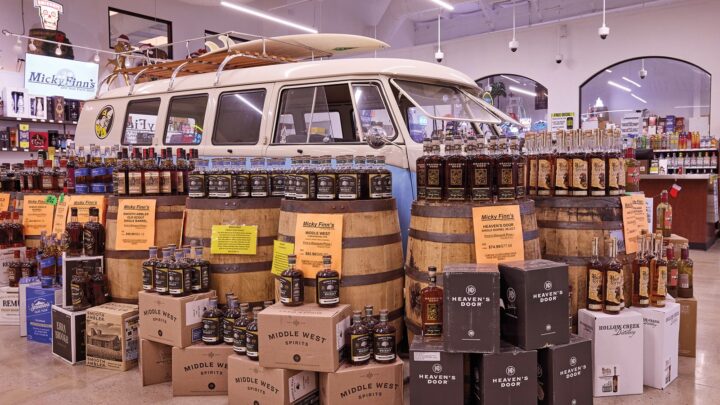
Micky Finn’s carries some 10,000 beer, wine, and spirits SKUs. Spirits are the big sales driver, accounting for 60% of sales, with wine and beer evenly split at 20% each. The stores offer more than 6,000 spirits SKUs, priced from $7 a 750-ml. of Taaka vodka to $8,000 for Hibiki 30-year-old, with Tito’s reigning as the No.-1 selling brand. Among categories, Bourbon, Tequila, and RTD cocktails are the best performers, Havekost notes. “Bourbon has seen an upward trend for the last 15 years,” he says. “Years ago, you couldn’t give Four Roses away. Today, people want private barrels of it.” Still, of late, the “Bourbon bubble has burst a bit,” the retailer continues, as “the unicorn brands are becoming more available.” For its part, Micky Finn’s is a big promoter of single-barrel Bourbons, offering 150-200 barrel picks a year.
Tequila is the latest craze at Micky Finn’s. Indeed, the newest store offers upwards of 1,000 different Tequilas, a selection that is larger than its Bourbon offerings. “We bring in every Tequila we can get our hands on,” Havekost says. “And it’s paid off.” The chain’s private-label spirits are also a draw at the I-95 store. Havekost points to Jacks & Dillon Handcrafted vodka ($21 a 1.75-liter), launched last year, as a standout.
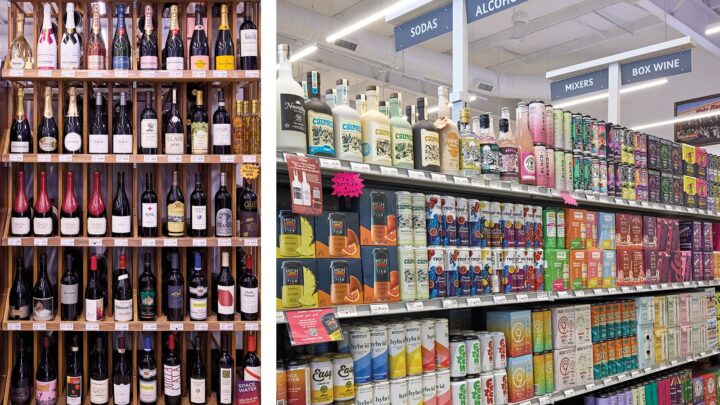
More than 2,000 wine SKUs are offered at Micky Finn’s, priced from Yellow Tail at $6 a 750-ml. to $400 for the 2018 Opus One. Top-selling varietals include Sauvignon Blanc and Pinot Grigio, Havekost says, as most wine drinkers in his market prefer chilled beverages. Kim Crawford Sauvignon Blanc ($17) is the chain’s top-selling wine. Regardless of the type, Havekost expresses concern about wine’s positioning. “Wine is challenged in that there are so many products, too many choices,” says the retailer. Moreover, for many consumers and store employees, wine requires a learning curve, he adds.
Similarly, Havekost believes the beer category is struggling today because of the vast proliferation of craft brews launched in recent years, consistent price increases, and competition from hard seltzers, RTDs, and most recently, CBD drinks. (In his stores, CBD beverages are merchandised in the beer section.) Micky Finn’s offers more than 1,500 beer SKUs, priced from $5 for a 6-pack of Pabst Blue Ribbon to $24 for a 4-pack of Karmeliet Tripel. Michelob Ultra ($16 a 12-pack of 12-ounce cans) is the chain’s top-selling beer.
Building Awareness
While Havekost says he’s “experimented with everything” when it comes to marketing, including billboards and radio, these days Micky Finn’s relies on digital executions to promote the stores. “Advertising 65has become relatively inexpensive compared to what it cost ten or 15 years ago,” he notes. “Today, you can reach 50,000 people in a keystroke.” In addition to its website, the chain utilizes social media platforms like Facebook, Instagram, and TikTok. Weekly e-mails blasts are sent to 40,000 customers while a frequent buyer program rewards customers with 1% back on purchases.
In-store tastings are held frequently at Micky Finn’s. In fact, demand for mixology classes from wholesale and store customers prompted Havekost to unveil The Sapphire Room by Finn’s, a fully-licensed events space located behind the chain’s second store, in 2025. In addition to bartender workshops and sampling events such as an Oktoberfest beer and food pairing, the venue can be rented out for parties, wine tastings, and even weddings. “The Sapphire Room was built to help my bar customers and has evolved into so much more,” Havekost says. “It also brings more awareness to my brand.”
Florence County residents are well aware of the contributions Havekost, his family, and Micky Finn’s make to the community and local organizations and fundraisers. Among the beneficiaries are the McLeod Health Foundation and the Florence Area Humane Society. Havekost credits his parents for instilling in him the responsibility of giving back. “It’s the right thing to do in a small town,” he says.
With three locations, Micky Finn’s has reached its Florence County maximum. But that doesn’t mean Havekost has stopped expanding. In addition to potential units adjacent to forthcoming Buc-ee’s, at press time, the retailer was working on the acquisition of a small chain of liquor stores elsewhere in the state. “Our next phase of growth will be through acquisition,” he says.
Whether growth comes through purchases or new store buildouts, one thing is certain: Rick Havekost and Micky Finn’s will play a role in the evolution of the beverage alcohol retail business in South Carolina.