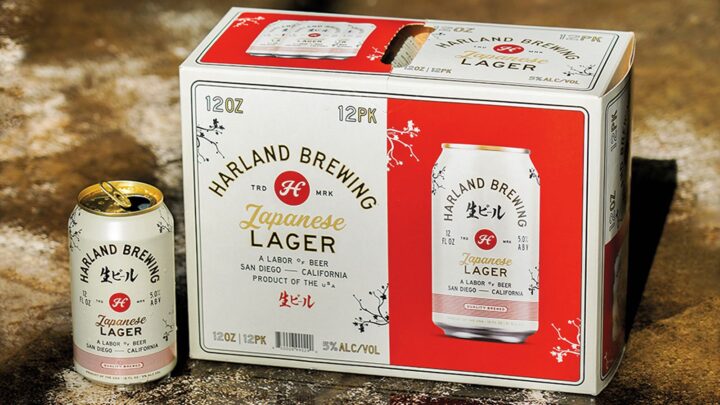
At San Diego’s Harland Brewing, the unique and increasingly popular beer style Japanese lager has quickly gained momentum. Launched in 2020, Harland’s Japanese lager—brewed with puffed jasmine rice and toasted rice flakes—now accounts for 36% of the brewery’s sales and is distributed throughout southern California and Arizona. “It’s our workhorse,” says Harland co-founder and president Anthony Levas. With Mexican-style lagers popular in his market, Levas notes that the brewery wanted to stand out. “Harland’s Japanese Lager is our unique spin on lagers,” he adds.
Japanese-style lagers from craft breweries are indeed having a moment, as there have been several new entries in recent years, though they’re still a tiny category so sales data is largely anecdotal. Typically brewed with an abv of 4%-5%, Japanese lagers are sessionable, crisp, and refreshing. They’re produced with flaked or other rice styles like jasmine, adjuncts once shunned by craft brewers. But Japanese lagers, including major brands like Asahi and Sapporo, are steeped in history, as German brewers helped establish production of the style in the 19th century. With lagers rising greatly in popularity, it’s not surprising that Japanese-inspired expressions are growing in awareness.
Brewers attribute increased demand to several factors. “Japanese lagers are light but flavorful. They drink easy and are crushable,” says Josh Pfriem, co-founder and brewmaster at Oregon’s pFriem Family Brewers, which has produced its own Japanese lager for about ten years, long before most other U.S. brewers. “They complement a lot of different food, including sushi and other Japanese dishes.” And not only do rice beers appeal to craft brew drinkers, “they also connect with consumers of domestic lagers,” he adds, due to their lightness and low abv.
“We wanted to take a modern craft approach to this historical style,” Pfriem says of the company’s Japanese lager, which is available year-round in 4-packs of 16-ounce cans ($12) and on draft in Oregon, Washington, Idaho, and southern California. It’s been a hit with consumers, with off-premise volume surging 47% last year, according to the brewer.
Harland’s Japanese lager, meanwhile, became “our No. 1 SKU in Los Angeles right out of the gate,” Levas says, and is currently “head-to-head” with the brewery’s Hazy IPA in the San Diego area. It’s available in 4-packs of 16-ounce cans ($13), 12-packs of 12-ounce cans ($20), and in both quarter and half kegs. Indeed, Japanese lagers have been so popular at the California brewery that for the last three years it has also offered Yuzu Japanese lager, Harland’s classic Japanese lager dosed with a hint of citrus from yuzu, as part of its limited-time-only specialty series. Featured as the beer of the month at Harland’s four San Diego taprooms in February, Yuzu Japanese lager sold out at two of the locations in just ten days. “The beer is on fire,” Levas exclaims.
At retail, Japanese lagers are starting to have a presence, especially in California. Sales of the beers have been “picking up as brewers increasingly focus on crisp, clear styles that are easy to drink,” says Craig Hood, beer buyer at Hi-Time Wine Cellars in Costa Mesa, California. In addition to the Harland brand, the store stocks offerings from Japan’s own Echigo and Orion ($11 a 4-pack of 16-ounce cans).
Japonica restaurants in southern California, meanwhile, are all in on Japanese rice lagers. For the last three years, the three-unit Japanese restaurant brand has offered its own Japonica rice lager, produced under contract by nearby El Segundo Brewing Co. “It’s light and refreshing. Everyone loves it,” says Jessi McCleary, director of operations at Sima Management, operator of the chain. In fact, Japonica rice lager—$9 a 16-ounce can and $30 for a 4-pack to go—is performing so well that it’s outselling both Asahi and Kirin at the eateries and is the restaurants’ No. 1 beer, McCleary says.
Levas encourages beer retailers to help educate customers about Japanese rice lagers, noting that with so many consumers drinking lighter, approachable styles these days, “they’ve got a lot of runway.”