Each year, Impact salutes the most promising smaller brands across the wine, spirits, and RTD categories with its “Hot Prospect” awards. This year, a total of 70 brands earned Hot Prospect accolades, with each showing stellar results despite the challenges of the difficult drinks market, and pointing the way forward as the industry strives to make new connections with consumers.
To qualify as Hot Prospects, brands must have achieved strong growth in the preceding three years or be significant new products. The full criteria is listed in each of the brand tables. For spirits and imported wines, brand volumes must be between 50,000 and 200,000 cases, while domestic \ wines and RTDs are between 50,000 and 250,000 cases.
While the spirits industry remains in a challenging period, with major marketers searching how to fully engage a new generation of consumers, there are bright spots across price points and categories. The 27 winning spirits Hot Prospects show that there’s still plenty of excitement to be generated in the industry, especially for agave spirits, which make up half of the winning brands.
Agave Spirits Lead The Way
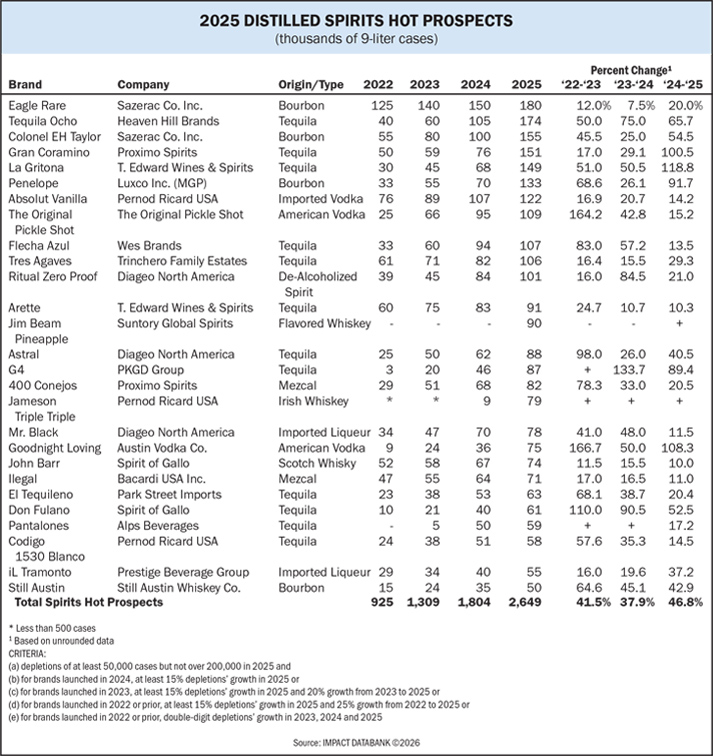
In total, 14 agave spirits (12 Tequilas and two mezcals), seven whiskies, three vodkas, two liqueurs, and one de-alcoholized spirit earned Hot Prospect honors for their 2025 performances, with 12 brands making the grade for the first time. Winning brands run the gamut from affordably priced entry-level spirits like Suntory’s Jim Beam Pineapple all the way up to higher-priced brands like Sazerac’s allocated E.H. Taylor whiskies and Pernod Ricard’s Codigo 1530 Blanco.
For 2025, Sazerac notched two Hot Prospects, including the largest winning brand, Eagle Rare. The Bourbon brand— previously highly allocated but becoming more common across the U.S. as Sazerac’s stocks age—was up 20% in 2025 to 180,000 cases. The brand, like many of Sazerac’s sought-after whiskies, has posted steady growth for years, limited by available supply. Following a substantial expansion of the Buffalo Trace Distillery, Sazerac’s whiskies are seeing increasing runway for growth.
Case-in-point is E.H. Taylor, Sazerac’s other Hot Prospect. Last year, the brand grew 54.5% to 155,000 cases. In 2022 the brand was substantially smaller at 55,000 cases and limited by allocation. The brand covers 14 offerings, though some of those are extremely limited releases, and has seen two additions to the lineup this year when Sazerac resurrected E.H. Taylor’s Four Grain Bourbon and Cured Oak Bourbon. “Colonel E.H. Taylor, Jr. was a true pioneer whose commitment to craftsmanship helped redefine what Bourbon could be,” said Charley Costa, brand manager, whiskey, Buffalo Trace Distillery. “Four Grain and Cured Oak reflect that legacy in distinct ways: one through an unconventional grain composition, the other through the influence of barrel aging. Together, they demonstrate how intentional innovation and a dedication to quality can produce truly distinctive whiskeys.”
Between Sazerac’s winning brands is Heaven Hill’s Tequila Ocho, the largest Tequila Hot Prospect for 2025. In 2025, Ocho rose 65.7% to 174,000 cases. “We see the highest rates of growth with our Reposado expression,” says global brand director for Tequila Ocho, Chris Dunn. With momentum building for the brand, Heaven Hill and the Tequila Ocho team are focusing on the provenance of its agave through Terroir Select Tequilas. “Over the next bunch of years, Terroir Select will highlight blue weber agave across eight specific and significant growing regions, each one being its own vintage,” says says global brand director for Tequila Ocho, Chris Dunn.
With momentum building for the brand, Heaven Hill and the Tequila Ocho team are focusing on the provenance of its agave through Terroir Select Tequilas. “Over the next bunch of years, Terroir Select will highlight blue weber agave across eight specific and significant growing regions, each one being its own vintage,” says Dunn.
In fourth place is Proximo Spirits’ Gran Coramino Tequila, a collaboration with comedian and actor Kevin Hart. Last year, the brand was up 100.5% to 151,000 cases in the U.S. Year-over-year, Gran Coramino has consistently notched double-digit growth. “We surpassed the $200-million mark in consumer sales three years into the business,” says Gran Coramino co-founder, president, and CEO James Morrissey. “We grew on volume 100% year-on-year, 2025 versus 2024, versus the category average of 2%. Consumer dollar sales were up 85%.”
Proximo Spirits also earned Hot Prospect honors for 400 Conejos mezcal, which has been a source of growth for the company, albeit from a relatively small base. Last year, 400 Conejos was up 20.5% to 82,000 cases, making it a leading brand in the mezcal category.
T. Edward Wines & Spirits’ La Gritona is another booming upscale Tequila and the first of two T. Edward brands to make the list. La Gritona grew 118.8% last year, reaching 149,000 cases in the U.S. The company’s second winning Tequila, Arette, grew 10.3% to 91,000 cases. Both brands won Hot Prospect honors for the first time for their 2025 growth. “[Our portfolio] was originally curated as a boutique, craft spirits book, but some of the brands have had really explosive growth,” said Anthony Zraly, chief growth officer. “Arette, produced by the Orendain family, has become one of our top revenue-producing brands at T. Edward.”
Outside of the five largest brands by volume, winning Tequila and mezcal brands include WES Brands’ Flecha Azul, which grew 13.5% to 107,000 cases; Trinchero’s Tres Agaves , which jumped 29.3% to 106,000; Diageo’s Astral , which was up 41% to 88,000; Gallo’s Don Fulano, which leaped 53% to 61,000; Bacardi’s Ilegal, which increased 11% to 71,000; Park Street’s El Tequileño, which grew 20.4% to 63,000; Alps Beverage’s Pantalones, which increased 17.2% to 59,000), and Pernod Ricard’s Codigo 1530 Blanco, which was up 14.5% to 58,000.
The final Hot Prospect-winning Tequila is PKGD Group’s G4. Last year the brand grew 89.4% to 87,000 cases. In 2022, G4 was only at 3,000 cases in the U.S. “G4 Blanco is still our largest SKU, but Reposado was a huge part of the 2025 growth story. We were able to make considerably more of it available, more consumers discovered it, and full-year sales grew approximately 252% over 2024,” said Shawn Miller co-founder and “chief right brain” of PKGD. “California is our largest U.S. market, followed by New York and Texas. Florida and Illinois are next, and Georgia, Colorado, and Arizona are also particularly strong G4 markets.”
Looking ahead, Miller said the biggest change for the brand will be increased availability. “We’ve been adding production capacity very deliberately so we can make more of the standard portfolio available while continuing to make G4 the way it should be made,” he said. “Marketing will expand as the brand grows, but I don’t think G4 needs to reinvent itself. We need to help more people discover it, understand why it’s distinctive and be able to find a bottle when they want one.”
Among whiskeys, the second-largest category among Hot Prospect winners, behind Sazerac’s winning pair is Luxco’s Penelope. The brand has been on the upswing since 2022 but saw growth accelerate tremendously in 2025 when the brand grew 91.7% to 133,000 cases. While the brand has long been known for its barrel-finished whiskies and limited offerings, Penelope recently launched new flagship Bourbon and rye releases. The pair—part of the new Classic Series—sees the brand squaring off in the super-premium tier against long-established brands like Suntory’s Maker’s Mark and Knob Creek.
“We’ve been talking about and working toward introducing Kentucky Straight Bourbon whiskey and Straight Rye whiskey for a long time, but we wanted to make sure they were perfect before releasing them,” said Michael Paladini, founder and vice president of sales at Penelope. The Bourbon retails for around $45 and the rye for around $35. Currently the releases are available in select markets with a nationwide push planned for the future.
Suntory’s lone Hot Prospect for 2025 is Jim Beam Pineapple, a new flavored extension that rocketed to 90,000 cases in its first year on the market. The flavor is on-trend and the release is aimed at creating simple and easy-to-enjoy drinks. “We’re outperforming the American whiskey category, and that’s thanks to our continued investments and activation,” says Suntory Global Spirits CEO Greg Hughes. “Consumers continue to vote on flavor, convenience, and sessionability, and that’s working for RTDs but also for simple Bourbon serves.”
Rounding out the winning whisk(e)y brands are Gallo’s John Barr, the only Scotch to make the list, at 74,000 cases after growing 10% in 2025; Pernod Ricard’s Jameson Triple Triple, up exponentially to 79,000 cases; and Still Austin’s portfolio, which rose 42.9% to 50,000 cases.
While Tequilas and whiskies have dominated the Hot Prospects winners in recent years, stalwart categories like vodka continue to see craft and innovative releases score early success. In vodka, the largest 2025 Hot Prospect is Pernod Ricard’s Absolut Vanilla at 122,000 cases, up 14.2% for 2025. Hot on its heels is The Original Pickle Shot at 109,000 cases. The brand—as the name suggests—is aimed at the shot occasion with Original and Spicy variants and grew 15.2% last year. The final vodka Hot Prospect is Goodnight Loving from Austin Vodka Co. In 2025, the brand grew more than 100% to reach 75,000 cases.
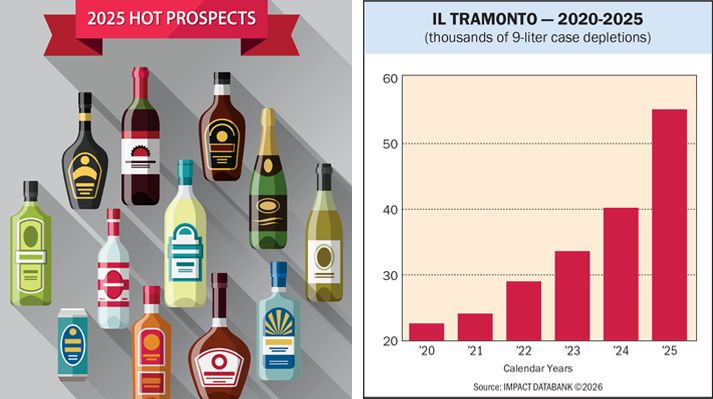
Three other Hot Prospects winners cover both liqueurs and non-alcoholic spirits, with two coming from Diageo. Ritual, Diageo’s non-alcohol spirits brand, grew 21% to 101,000 cases, showing that there remains vitality in the zero-proof space. For the liqueurs, Diageo’s coffee liqueur Mr. Black is the largest, up 11.5% to 78,000 cases. Finally, there’s Il Tramonto from Prestige Beverage Group. The Italian import jumped 37.2% to 55,000 cases in 2025.
15 RTDs Earn Honors
Ready-to-drink and ready-to-serve products continue to be a driving force in the wine and spirits industry. The 15 Hot Prospects RTDs for 2025 reflect a mix of established trends still on the upswing and new-to-market concepts that are starting to catch fire.
“The biggest flavor trend today is not the emergence of a single dominant flavor, but the growing role of taste and variety as primary drivers of consumer choice. RTD as a category rooted in flavors is a great example,” said Zach Poelma, Southern Glazer’s senior vice president of strategy and insights. “While fruit (up 9.5% versus a year ago) remains the foundation of flavored spirits, growth is increasingly being fueled by cocktail-inspired offerings (up 33.7%) and emerging flavors such as lemonade, limeade, and tea—all of which are up strong double-digits.”
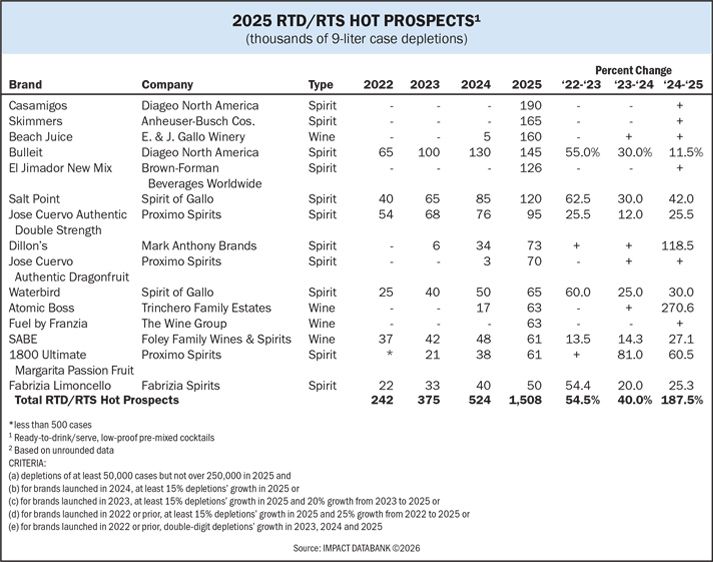
Diageo’s Casamigos RTDs represent the largest 2025 Hot Prospect, reaching 190,000 cases in their first year on the market. While initially testing the water with Margaritas in 2025, the brand has doubled down this year, increasing its emphasis on the more portable pre-packaged cocktails. Addressing investors earlier this year, Diageo North America CEO and president John O’Keeffe noted that the company is adjusting pricing on the core Casamigos Tequila to improve its performance.
O’Keeffe said the recent promotion for Casamigos and the FIFA World Cup “has turned around its three-year share decline to a winning share of total spirits for the last seven to eight weeks. I am also encouraged by the traction we are getting with Casamigos Margaritas in the Cocktail Collection, which is seeing high double-digit growth, in addition to Casamigos Margaritas in the 200-ml. can.”
In addition to Casamigos, Diageo has found recent success with its Bulleit RTDs. In 2025, those grew 11.5% to 145,000 cases. While initially launched in 375- and 750-ml. 39bottles, Diageo extended the Cocktail Collection, including the Bulleit Old Fashioned, into the single-serve space with 100-ml. cans. “The Cocktail Collection was built on the idea that a bar-quality cocktail should be easy to enjoy anywhere,” said Peter Sundry, brand director of the Cocktail Collection. “This launch is about meeting people where they are gathering most this summer, with a delicious cocktail that tastes freshly made and is ready to enjoy with the crack of a can.”
Recently, Diageo has addressed its role in the RTD category and concluded that the company is underweight. On a call with reporters, Diageo CEO Dave Lewis said he’s not interested in either acquisitions or disposals of brands at the moment, noting that valuations are currently too low to think about offloading underperforming labels. “The turnaround of Diageo is an organic turnaround,” he said. “We are not thinking about M&A, and I want people to be really clear about that. We have what we need to turn our business around.”
The second-largest RTD Hot Prospect is Skimmers from Anheuser-Busch. A new contender in the spirits-and-tea subcategory that launched last year, the brand reached 165,000 cases in its debut and is a growing part of A-B’s increasingly potent lineup of wine- and spirits-based RTDs that also includes Cutwater, Beatbox, and Nütrl, all multimillion-case brands and industry leaders.
Skimmers hits the familiar beats for iced-tea-and-vodka drinks, coming in a variety of flavors and at 4.5% abv and 100 calories per can. “Particularly in the RTD space, variety packs play a key role because consumers are driven by flavor exploration, and variety is essential to driving trial,” said Southern Glazer’s Poelma.
Following Skimmers is Gallo’s Beach Juice, one of the RTD leader’s three Hot Prospect-winning brands. Beach Juice reached 160,000 cases last year, growing exponentially. Gallo’s other honorees include Salt Point, up 42% to 120,000 cases; and Waterbird, which climbed 30% to 65,000 cases. “The RTD category continues to be super dynamic and fast-paced,” said Britt West, Gallo’s chief commercial officer. “With Beach Juice, our zero-sugar offering in 500-ml. Tetra, we’re very happy with the early results, particularly with the dollars for point of distribution that it’s driving. We’re going to continue working to expand that. The most important thing is adapting our innovation processes for the pace at which innovation occurs in RTDs. It’s just so rapid.”
Also among the five largest RTD Hot Prospects is Brown-Forman’s New Mix. Last year the brand reached 126,000 cases in its first year in wide U.S. distribution. The brand launched with two flavors—Paloma and Cantarito—both made using El Jimador Tequila. While new to the U.S., New Mix is a juggernaut abroad. With a strong following in Mexico, it’s at 12.9 million cases globally, making it the 10th-largest premium spirits brand in the world.
Proximo’s largest Hot Prospect in the premixed space is Jose Cuervo Authentic Margarita Double Strength. The release has seen growing momentum, rising 25.5% to 95,000 cases in 2025. The brand’s Double Strength line comes in at 20% abv and is sold in 1.75-liter bottles. Proximo also found success in 2025 with two other RTS Margaritas earning Hot Prospects honors. Under the Cuervo brand, the company’s Dragonfruit Margarita grew to 70,000 cases in 2025, up from a base of 3,000 the year before. For 1800, Proximo is seeing substantial growth for its Ultimate Margarita Passion Fruit, which grew 60.5% to 61,000 cases.
“Innovation is expanding beyond traditional flavors into emerging territories such as tea, botanicals, tropical blends, savory and spicy profiles, and globally inspired flavors,” said Southern Glazer’s Poelma. “Successful innovation is not just about introducing a new flavor but creating a flavor experience that is relevant to a specific occasion, consumer need, or aligned with a cultural trend.”
Mark Anthony Brands’ Dillon’s line of canned cocktails earned its first Hot Prospect award after seeing explosive growth in 2025. Last year, the brand grew 118.5% to 73,000 cases. In 2023, Dillon’s was at 6,000 cases. The brand is relatively unique in the RTD space in that it markets a variety of gin-based cocktails. Outside of unique propositions like portfoliomate the Finnish Long Drink, gin is a less common base spirit among RTDs growing in the U.S.
While the bulk of the RTD Hot Prospects for 2025 are spirits-based, there are four wine-based brands that made the grade. Behind Gallo’s Beach Juice there are a trio of wine-based brands carving their own niches. Trinchero’s Atomic Boss brand grew 270% last year, rising to 63,000 cases. Also at 63,000 is the Wine Group’s Fuel by Franzia, earning Hot Prospect honors in its first year on the market. Finally, there’s Sabe by Foley Family Wines & Spirits, which surged 27.1% to 61,000 cases in 2025.
All three of those wine-based brands are offered in individual packages and come in at above 10% abv, following the successful trend set by brands like Beatbox. While Foley’s wine-based RTD aims to recreate classic cocktails, Fuel by Franzia and Atomic Boss are aimed at delivering bold flavors, calling their drinks “Hard Punch” among other descriptors.
“Suppliers are moving beyond traditional line extensions and investing in more distinctive, differentiated flavor platforms,” says Poelma. “RTDs have been at the forefront.”
Wine Roster Features 28 Standouts
A total of 28 brands from the wine category earned Hot Prospect honors this year, including 15 labels that are new to the list. Among domestic winners, California leads the way, accounting for 12 of the 14 brands that made the grade. Nine of the 14 domestic honorees are new Hot Prospects this year.
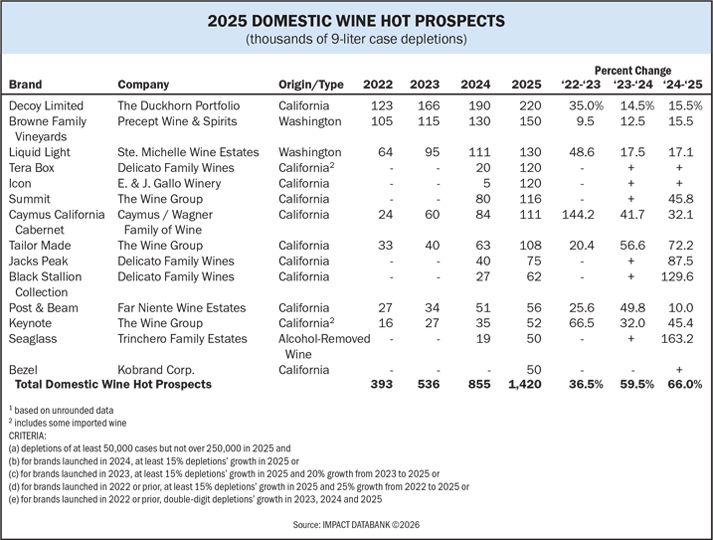
That includes largest label Decoy Limited, the higher-priced offshoot of the Duckhorn Portfolio’s 1.5-million-case Decoy franchise. Decoy Limited has been on a rapid growth track and climbed past 200,000 cases in the U.S. in 2025. Earlier this year, Decoy Limited was bolstered with two new releases: a Sauvignon Blanc and a Cabernet Sauvignon in the $20-$30 price range. The Sauvignon Blanc, carrying a North Coast appellation, uses grapes from Sonoma County and Mendocino County. The Cabernet is made from Napa grapes from the 2023 vintage and aged for two years in 40% new French oak.
“We continue to see strong demand from consumers who want elevated, appellation-led wines that still feel accessible,” says Chanel Caplan, senior vice president of brand management for the Duckhorn Portfolio. “These new releases build on our momentum in the $20–$30 segment and support Decoy’s role as one of the few premium wine brands successfully expanding upward into the luxury segment.”
Another big name in California wine, Caymus, made the list with its California-appellated Cabernet Sauvignon, which has more than quadrupled in size to above 100,000 cases in the space of four years. Earlier this summer, Caymus tapped Reyes Beverage Group for distribution across Arizona, Louisiana, Maryland, Oklahoma, Texas, and Washington, D.C. Reyes added the full Wagner Family of Wine portfolio in those states. While Caymus California Cabernet is on a strong upswing, larger portfoliomate Bonanza recently earned “Hot Brand” honors after climbing 27% to 572,000 cases in the U.S. last year.
Like Caymus California Cabernet and Bonanza at Wagner Family, Post & Beam is an entry point into the portfolio at Far Niente Wine Estates. The brand has doubled in size since 2022 to 56,000 cases. In addition to Post & Beam, the Far Niente range includes the namesake brand, Nickel & Nickel, Dolce, Bella Union, and EnRoute, with total production above 150,000 cases in recent years.
Black Stallion, the Napa Valley brand from Delicato Family Wines also earned honors by doubling to more than 60,000 cases last year. In the second half of this year, Black Stallion’s Heritage tier is getting a new look across its Meritage, Chardonnay, Pinot Noir, and Cabernet Sauvignon wines intended to reinforce its super-luxury positioning. Delicato is also present on the domestic wine list with Jacks Peak, which includes Cabernet, Pinot Noir, Chardonnay, and Pinot Grigio offerings, as well as Tera Box, which sells at Aldi and topped 100,000 cases last year.
Last year, Napa Valley winemaker Cakebread Cellars introduced Central Coast wine brand Bezel into national distribution. Bezel includes a Cabernet Sauvignon, Chardonnay, Pinot Noir, and Sauvignon Blanc, with the wines sourced from the Paso Robles and San Luis Obispo Coast AVAs. Bezel got off to a fast start, depleting 50,000 cases in its debut. The brand is intended to broaden Cakebrand’s portfolio beyond Napa Valley as well as into new occasions. Bezel is handled nationally by Kobrand.
Wine market leader Gallo is represented on the domestic list with Icon, a range of high-abv Moscato-based wines that come in flavors like Blackberry, Peach, and White Moscato that hit 120,000 cases last year. Also in the accessibly priced segment is Keynote from The Wine Group, which topped 50,000 cases, as well as portfoliomate Tailor Made, which is now above 100,000 cases with offerings including a Cabernet Sauvignon, Bourbon Barrel Aged Cabernet Sauvignon, Chardonnay, Creamy Chardonnay, Pinot Noir, and Red Blend. The Wine Group’s 3-liter boxed brand Summit also earned honors, having jumped 46% to 116,000 cases in 2025.
Trinchero Family Wine & Spirits saw the alcohol-removed offshoot of its Seaglass label prosper in its second year on the market, more than doubling to reach 50,000 cases. The broader Seaglass franchise grew 6.7% to 633,000 cases in 2025.
Two Washington wine labels also earned Hot Prospect status, including Liquid Light from Ste Michelle Wine Estates and Browne Family Vineyards from Precept Wine & Spirits. Liquid Light is now the seventh-largest brand in the Ste Michelle stable at 130,000 cases, having doubled since 2022. Browne Family Vineyards is the family label of Precept cofounder and CEO Andrew Browne, and sources its wines primarily from the Browne Estate Vineyard in the Spring Valley District of Walla Walla and the Columbia Valley AVA.
Old And New World Options
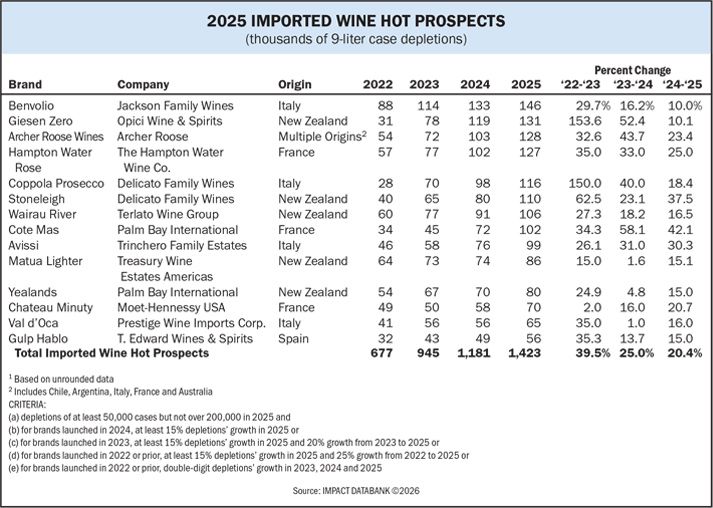
The imported wine segment of Hot Prospects is led by New Zealand with five entries, along with four Italian brands and three French labels. Six members of the import list are new Hot Prospects this year, out of a total of 14 winners.
The largest of the New Zealand contingent is Giesen Zero, from Opici Wine & Spirits. The brand has expanded by 100,000 cases over the past three years, according to Impact Databank . While the brand’s 0% Sauvignon Blanc has led the way, Giesen’s non-alcohol lineup also includes Pinot Grigio, Riesling, Red Blend, and Chardonnay. “In the last six months, we’ve launched our Spritz range, including a Sauvignon Blanc Spritz and Rosé Spritz, and they come in both 750-ml. bottles and 250-ml. slimline can form as well,” says Giesen general manager Richard O’Brien. “These are sessionable, fun drinks for the younger crowd, and the canned format has real opportunity in this space.”
Also in the better-for-you segment is Matua Lighter, from Treasury Wine Estates, which grew 15% to 86,000 cases last year. The broader Matua brand is now at 870,000 cases stateside. Fellow kiwi labels Stoneleigh, Wairau River, and Yealands likewise earned honors.
Wairau River Winery, imported by Terlato, recently introduced Braided, made from Pinot Grigio and Sauvignon Blanc. The newcomer takes its name from the distinctive braided channels of the Wairau River in Marlborough where the winery is based. Braided retails at $18 a 750-ml. Yealands, meanwhile, is part of the Palm Bay stable and has seen steady growth that propelled it to the 80,000-case mark last year. From Delicato, Stoneleigh surged 38% in 2025 to surpass 100,000 cases. “Stoneleigh is doing really well with its Sauvignon Blanc at the $14 price point,” Delicato CEO Chris Indelicato says.
Jackson Family Wines’ Benvolio is the largest label among imported Hot Prospect wines. The brand includes Prosecco, Pinot Grigio, and Rosso bottlings and is likely to cross the 150,000-case threshold this year. Prosecco has also been a winning play for Avissi from Trinchero Family Wine & Spirits, Delicato’s Coppola, and Val d’Oca from Prestige Wine Imports. “The Prosecco has been a home run” for Coppola, Indelicato noted. Avissi has been contributing to momentum in sparkling for Trinchero, and should easily cross 100,000 cases in 2026. Prestige’s Val d’Oca jumped 16% to 65,000 cases last year, and has seen solid on-premise gains in recent years.
A trio of French wine labels earned honors, among them Côté Mas from Palm Bay International, Hampton Water rosé, and Chateau Minuty from Moët Hennessy. Côté Mas, part of the portfolio of Languedoc winemaker Jean-Claude Mas, includes red, white, and rosé 1-liter bottlings, as well as Cremant de Limoux sparklers. The brand crossed 100,000 cases last year on 42% growth, with just under half of volume accounted for by its rosé, which has tripled in size since 2022.
Hampton Water, led by Jesse Bongiovi, jumped 25% to 127,000 cases in 2025, continuing its strong growth run. Bongiovi sees the Hampton Water brand as a way to bring quality wine to consumers who may be intimidated by appellation- and varietal-focus marketing cues that appeal to older drinkers. “My whole thinking became, if you could get that great French liquid but communicate to the 23-year-old who doesn’t know where to start when they walk into a wine store, then you could help people bridge that gap.”
Also competing in the rosé category is Moët Hennessy’s Chateau Minuty, in which the luxury giant took a majority stake in early 2023. After rising 21% to 70,000 cases in the U.S. last year, the brand continues to show momentum in 2026, complementing the larger Chateau d’Esclans label in Moët Hennessy’s rosé stable.
Among the larger imported wine Hot Prospects this year is Archer Roose, which includes wines from Chile, Argentina, Italy, France, and Australia. The brand’s lineup fields canned offerings such as Bubbly, Bubbly Rosé, Rosé, Pinot Noir, Malbec, Sauvignon Blanc, and Pinot Grigio. Most recently, Archer Roose added a new French Chardonnay sourced from Côtes de Gascogne in 4-packs of 250-ml. cans.
Also making the grade is Spanish wine brand Gulp Hablo, produced by the Parra Jimenez family and imported by T. Edward Wines & Spirits. Gulp Hablo recently launched a “Gulp Goes With You” marketing campaign backing the debut of its canned wine collection. Gulp Hablo’s canned wines include White (100% Verdejo), Orange (Verdejo and Sauvignon Blanc), Rosé (100% Garnacha), and Fresco, a chilled red blend. Gulp Hablo increased 15% to 56,000 cases in the U.S. market last year.