
The U.S. market’s Canadian whisky category continued its downward trajectory last year, as competition intensified across the spirits market and the growing RTD and non-alcoholic segments captured a greater share of consumer attention. Total Canadian whisky volume, excluding flavors, declined 6% to roughly 9.92 million 9-liter cases in the U.S. in 2025, according to Impact Databank, falling below the 10-millioncase mark for the first time in decades. That total is now less than half the category’s 22.44 million cases recorded in 1980. While Canadian whisky has gradually declined from that historic high, volumes had remained relatively stable through much of the early 2000s before more dramatic declines in recent years.
All of the top ten Canadian whisky brands in the U.S. posted volume drops in 2025, though those figures exclude flavored extensions from leading brands. Crown Royal remains the category’s leading unflavored Canadian whisky, with its core offering gaining significant share over the past two decades, from roughly one-quarter of the category in 2005 to about one-third last year. Second ranked Black Velvet held a 12.9% share of Canadian whisky depletions, while other brands like Canadian Mist and Rich & Rare now account for about 7% each.
The picture shifts when flavored Canadian whiskies enter the mix. Fireball continues to dominate the segment, depleting 7.65 million cases in the U.S. in 2025 despite a 2.5% volume decline. Meanwhile, Crown Royal’s broad portfolio of flavored extensions demonstrate a more dynamic side of the category. Long-established Regal Apple posted 1.56 million cases, while newer innovations are quickly gaining traction, with Crown Royal Chocolate approaching 300,000 cases in its first year on the market.
Still, Canadian whisky faces a challenging U.S. landscape, as economic pressures weigh on consumer spending, competition for drinking occasions intensifies, and ongoing trade tensions create added uncertainty for Canadian producers. Those challenges have mounted this year, with a 50% U.S. tariff on certain Canadian alcoholic beverages taking effect in August as part of an escalating trade war followed by new restrictions in late September that exclude non-bulk Canadian alcohol imports from the U.S. market.
But opportunities remain for the category. Global markets not subject to the same trade pressures could provide targeted avenues for growth, while continued innovation in flavors, formats, and drinking occasions offers brands more ways to engage new consumers and bring them into the broader Canadian whisky category.

Core Brands Under Pressure
While the Canadian whisky category has contracted substantially over the past several decades, shedding more than 5 million cases since 2000, the impact has not been evenly distributed across all leading brands.
Crown Royal has continued to strengthen its position as the category leader even as the overall market has shrunk. Excluding flavors, Crown Royal volume declined 8% in 2025 to 3.29 million cases in the U.S., still more than twice the volume of second-ranked Black Velvet. In 2005, when the Canadian whisky category totaled 15 million cases, Crown Royal held a 24.5% share. Two decades later, despite the category contracting to 9.9 million cases, Crown Royal’s share had increased to 33.2%. In other words, while Crown Royal has not avoided the pressures facing the overall category, it has onsolidated its leadership within unflavored Canadian whisky.
While core Crown Royal volume fell to just under 3.3 million cases in the U.S., its sizable flavored portfolio—including Regal Apple, Peach, Blackberry, Vanilla, Chocolate and Salted Caramel—combined for nearly 3.7 million cases. That growth points to the increasing importance of flavor innovation to the broader Crown Royal franchise.
The other leading Canadian whisky brand above 1 million cases in the U.S., Black Velvet, declined 9% across its core unflavored portfolio in 2025. At 1.28 million cases, the unflavored lineup accounts for the vast majority of the brand’s U.S. volume, while the leading flavored offerings Black Cherry and Apple combined for 50,000 cases last year, down 6.5%.
Parent company Heaven Hill Brands is now raising Black Velvet’s profile with the new Velvet Collection, a range of premium aged whiskies. The collection is launching with a Signature 12-year-old, Tawny Port Finish 12-year-old, Select Rye Recipe 15-year-old, and Heritage 20-year-old, each of which the company says offers a distinctive experience while maintaining a connection to the core brand.
“Across the collection, we’re exploring age, recipe, and finishing, giving whisky drinkers something to discover whether they’re looking for a great everyday pour or something a little more special,” said Aaron Wilke, associate vice president of Legacy Brands and Operations Integration at Heaven Hill. “One of the strengths of the collection is its range. You can find an approachable aged whisky for an everyday pour, explore a different recipe or finish, or reach for a 20-year-old whisky when you want something special.
While Heaven Hill Brands is bullish on the opportunities the new Velvet Collection will bring and remains committed to innovation that aligns with Black Velvet’s identity, the company is also closely monitoring the evolving trade environment and assessing its potential impact on the business. “We remain confident in Black Velvet and optimistic about the future of the brand,” said Wilke. “There are some important new chapters ahead, and our focus remains firmly on building for the long term.”
Third-ranked Canadian Club continued its downward trajectory in the U.S. last year, shedding 4.5% to 835,000 cases in the U.S. By comparison, Suntory Global Spirits’ Canadian whisky brand stood at just under 1.1 million cases in the U.S. in 2021. Still, Canadian Club continues to command roughly 8% of the category share. On the global stage, Canadian Club also ranks third, with volume declining 7.5% to 1.64 million cases, narrowly ahead of Black Velvet at 1.63 million cases.
While all of the leading unflavored Canadian whisky brands lost ground in the U.S. in 2025, a handful proved relatively resilient amid the broader category contraction. Fourth-ranked Rich & Rare declined 2% to 740,000 cases, while Windsor Supreme was nearly flat, shedding 0.5% to 642,000 cases. Pendleton, meanwhile, declined 2% to 495,000 cases. The more modest losses point to a challenging year across the category, but also show that the pressure was far from uniform as Canadian whisky brands navigate shifting demand and market pressures in their largest export market.

Innovation Offers Opportunity
Flavor expressions still offer growth opportunity for Canadian whiskies, but several leading brands have declined in recent years. Flavored offshoots alone have not been enough to reverse the broader pressures facing the Canadian category. But the segment’s leading brands continue to command sizable volume totals, while new expressions are driving sales and giving established franchises new avenues to compete.
Cinnamon-flavored Fireball remains one of the U.S. spirits market’s dominant players. Despite a 2.5% decline last year, the flavored category leader still commands a 7.65-million-case U.S. volume total and retail value of $1.54 billion. Even with Fireball’s significant footprint, parent company Sazerac is finding new ways to extend the franchise.
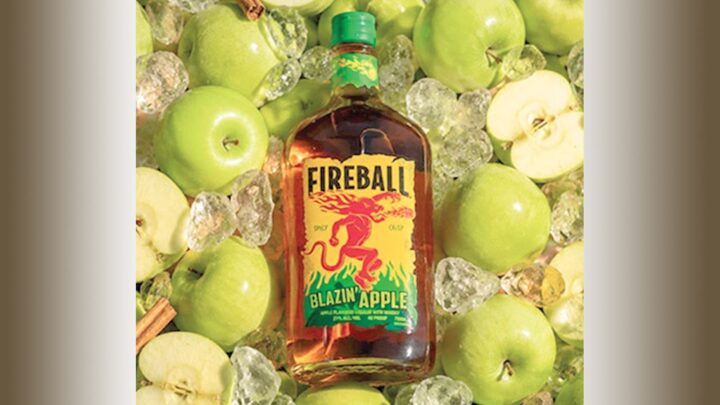
Last September, Fireball Blazin’ Apple debuted as the first flavor extension in the brand’s history, expanding a portfolio that previously only covered spirit-, wine-, and malt-based cinnamon-flavored offerings. The permanent extension shot ahead to 330,000 cases in its first year on the market, demonstrating the potential for flavor innovations to generate volume even within an established franchise. Sazerac has continued that push into 2026, releasing the limited-time Fireball Torch’d Vanilla nationally in August, pairing vanilla with the brand’s signature cinnamon whisky.
Complementing Canadian whisky’s top brand, Crown Royal’s popular flavored franchise is a volume leader in its own right. Crown Royal Regal Apple boasted roughly 1.56 million cases in the U.S. in 2025 despite a 5.5% volume decline. The expression approached the 2-million-case mark in 2021 and has gradually shed volume since. But Crown Royal has continued to expand its flavored lineup with extensions that have proven successful. In fact, six of the top 10 flavored Canadian whisky brands come from the Crown Royal portfolio. Those six flavored expressions totaled nearly 3.7 million cases in the U.S. last year, exceeding the roughly 3.3 million cases achieved by Crown Royal’s core unflavored portfolio, highlighting how important flavor has become to the franchise.
The brand’s leading flavors include third-ranked Crown Royal Peach, at 665,000 cases last year, and newer entrant Blackberry, which held up better than many leading flavors, declining just 2.5% to nearly 600,000 cases. Crown Royal Vanilla, Chocolate, and Salted Caramel also rank among the segment’s top ten.
Recent launches show how Crown Royal is using flavor innovation to add volume even as established expressions mature. Crown Royal Chocolate, released last year, reached nearly 300,000 cases in the U.S. in its first year on the market. Blackberry has been an even bigger success. Introduced by Diageo in March 2024, Crown Royal Blackberry surged to 610,000 cases in its debut year. While volume slipped 2.5% in 2025, the expression still depleted 595,000 cases, ranking it among the largest flavored Canadian whiskies in the market.
The Road Ahead
The overall Canadian whisky category remains under pressure in the U.S., with tariffs and evolving the ban on non-bulk whiskies adding new layers of uncertainty for brands already competing for fewer traditional whisky occasions. But the response from leading players suggests Canadian whisky isn’t standing still. From premium aged and finished expressions to a steady pipeline of new flavors, suppliers are finding new ways to reinvigorate established franchises and reach new consumers beyond the category’s traditional base. Those efforts may not immediately reverse Canadian whisky’s long-term volume decline, but they could prove increasingly important in determining the category’s path forward.