
Mindful consumption is a key consideration for many wine drinkers these days, a reality that is resulting in both challenges and opportunities for wine producers. The challenge, of course, is lower consumption levels overall. But among the opportunities are new growth areas for both lower calorie/lower alcohol wines and for non-alcohol wine options. The latter sector—non-alcohol wines—is expanding in theU.S. market, a small but welcome respite for the many producers who are struggling to find growth in the standard wine segment. Impact Databank estimates the non-alcohol wine market totaled roughly 1.8 million cases in 2025, a 12.5% increase from the previous year.
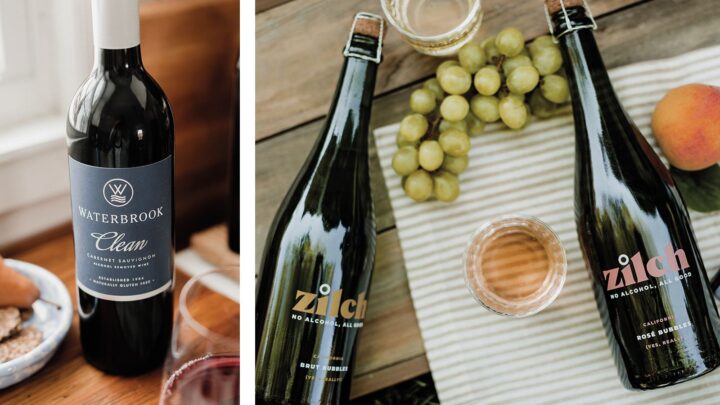
“Demand for non-alcohol wine continues to grow,” says Alex Evans, chief marketing officer for Precept Wine Spirits, which offers Waterbook Clean and Zilch in the non-alcohol wine segment. “The trends we’re seeing reflect a meaningful shift in how consumers think about their drinking habits across a diverse consumer base.” Brie Wohld, vice president of marketing for Trinchero Family Wine And Spirits, also sees demand rising but says the sector is entering “a more mature phase” of development. “This tracks with our understanding about consumer choices in this segment—it’s about moderation and flexibility,” she says.
Flexible Approach
Would says a majority of non-alcohol wine buyers also purchase traditional alcohol beverages. “The category brings in new consumers who wouldn’t otherwise engage with alcohol, while also resonating strongly with existing wine drinkers,” she says. “That 76% of consumers who purchase non-alcohol wine also purchase full abv wine tells us non-alcohol is expanding the category rather than cannibalizing it, creating incremental occasions and broadening the definition of wine consumption.”
In fact, non-alcohol wine is gaining a secure place in the consumption repertoire of many consumers, notes Evans. She points to analysis that the average consumer touches roughly eight different beverages throughout their day. “Non-alcohol options are increasingly earning a place in that rotation—not always because consumers are abstaining entirely, but because they’re choosing it as a legitimate adult beverage experience in its own right,” she says.
The increasing acceptance of non-alcohol wines comes at a time when health and wellness are top of mind for many consumers. The focus has brought such consumer trends as “Dry January,” when consumers abstain from alcohol for the month, and it’s similarly minded cousin, “Sober October,” to the fore in recent years. Those are still relevant and often produce a spike in sales, marketers say, but the depth of commitment goes well beyond.
“Dry January has effectively evolved into what many are calling Damp January,” says Evans. “The seasonal, all-or-nothing focus has softened, which we find to be a healthy sign for the category. While the hyperfocus attention from retailers and press naturally fades, we have seen more genuine integration into people’s lives and therefore category normalization and steady, sustainable growth.”
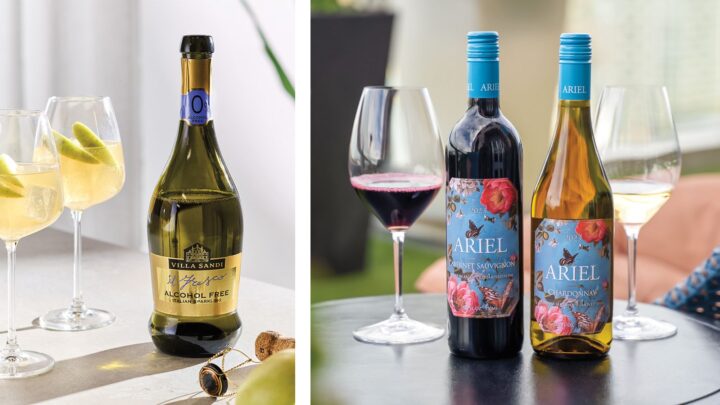
Diva Moretti Polegato, vice president and export area manager for the UK, U.S., and Mexico at Italy’s Villa Sandi, which offers Villa Sandi Il Fresco 0.0 non-alcohol sparkling wine, agrees, saying demand for no-alcohol wine is moving beyond the novelty phase. “Consumers are no longer engaging with these options just for Dry January or Sober October,” she says. “They genuinely want to explore and experiment with alcohol-free wines as a complementary choice. People are looking for the flexibility to alternate between alcohol and non-alcohol options while still enjoying 47the ritual, social, and sensory aspects that make wine special.
“As a winery, we see this as an opportunity to encourage moderation rather than abstinence,” she continues. “The trend is also reflected in the rise of mocktails—many bars and restaurants now have dedicated mocktail menus, and as producers of sparkling wines, we’ve noticed growing demand for sparkling options that are alcohol-free in these settings as well.”
New Brand Competition
The growing enthusiasm has sparked a wide range of new offerings in the non-alcohol wine sector. Some are entirely new brands. Others are line extensions of existing full-alcohol wine brands. The activity bodes well for the non-alcohol wine category, but some retailers are cautious.
“The non-alcohol wine category is definitely tracking along other emerging category trends,” says Jeremy Brock, chief buying officer for Garfield’s Beverage Warehouse in Naperville, Illinois. “We have seen a little bit of growth followed by the market getting saturated. We are trying to find the balance in this category of the correct size set to warrant the current and future sales. Along those lines is the struggle that we are facing in shelf space. The low-and-no-alcohol category warrants a section but it hasn’t eclipsed the point to warrant a full store reset yet.”
At Drinx Advisory in Smithfield, Rhode Island, wine director Andrew Thompson says “premium and flavor-forward non-alcohol wines” such as Seaglass, Mionetto and Fre are performing well, while red wines and some more traditional alcohol-free sparkling wines are struggling. Overall, he’s a bit weary of more. “Too many brands are entering the market,” he says, noting that “the top ten SKUs account for over 50% of volume” in his store.
In a growth market, however, new brand introductions are inevitable. Among the most high-profile recent launches was the June 2025 release of Josh Cellars Non-Alcohol Sparkling ($18 a 750-ml.), a line extension to the hugely popular Josh Cellars brand. At the time of the launch, Dan Kleinman, chief brand officer at Deutsch Family Wine & Spirits, said the release will “help shape the future of the beverage industry, and we know that non-alcohol offerings are part of that future.” Impact Databank estimates that Josh Cellars Non-Alcohol Sparkling depleted roughly 20,000 cases last year.
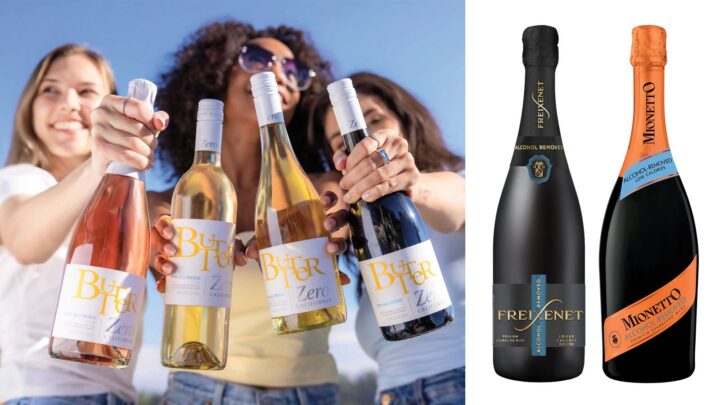
Butter Wines, maker of the well-known Butter Chardonnay and ButterLight Chardonnay, launched Butter Zero($13 a 750-ml.) earlier this year. John Truchard, founder of Butter Wines, and CEO of John Anthony Wine & Spirits, says the company tested the waters first with ButterLight Chardonnay, released in January 2025. Consumer reception prompted the company to push further, tackling the no-alcohol sector.
“We took that same approach to quality in the development of Butter Zero—if it doesn’t taste great, we won’t make it,” Truchard says. “When the first trials came in, we knew we were going to be able to make something worthy of the Butter brand name and then kept refining it so that quality and calories at less than 0.5% alcohol tasted great.”
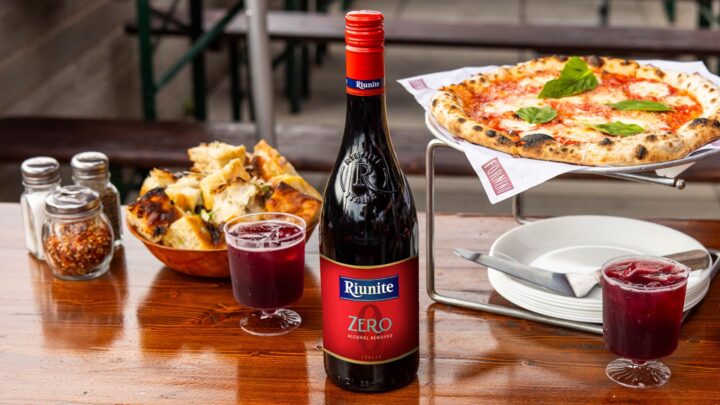
Riunite is also capitalizing on its well-known name. Cantine Riunite in September 2025 introduced two new non-alcohol wines to the U.S. market: Riunite Zero Red Semi-Sparkling ($9 a 750-ml.) and Maschio Zero White Sparkling ($13). The launch is supported by a “100% Italian. Zero Proof” campaign.
Those three newer entrants join other established non-alcohol wines that are linked by name to a standard wine. Brands like Mionetto, Stella Rosa, Freixenet, Waterbrook, Cupcake Vineyards, and more have successfully launched non-alcohol line extensions.
Enore Ceola, CEO of Freixenet Mionetto USA and executive vice president for North America for the global company, says line extensions offer key advantages. “For consumers, we see that they are more comfortable with trying new products from well-established brands rather than native non-alcohol brands,” Ceola says.
Evans of Precept Wine & Spirits, which has Waterbrook wines in its portfolio, says Waterbrook Clean has “benefited enormously in markets where the Waterbrook name already carries weight. When a winery that consumers already have a relationship with launches a non-alcohol expression, it lowers the barrier to trial significantly.” And Butter Zero’s Truchard says having options within a portfolio makes sense. “Wine occasions have definitely evolved beyond the dinner table and with those broader occasions, consumers want choice in alcohol levels, sometimes within the same occasion,” he says.
Brand cannibalization can be a concern, but evidence points to brand expansion instead. For example, Matt Munn, president of Frederick Wildman & Sons, which imports Cantine Riunite wines, says, “Riunite Zero is primarily attracting a new and incremental consumer rather than converting existing Riunite drinkers. We are not seeing a meaningful shift of our traditional Lambrusco consumer into the non-alcohol segment.
“Instead, Zero is bringing in a younger demographic, typically under 40, with a strong concentration in the 20–30 age range,” Munn continues. “These consumers are either abstaining from alcohol altogether or actively moderating their intake as part of a broader lifestyle shift. Many fall into Gen Z and Millennial cohorts who are more health-conscious and open to non-alcohol alternatives.” Munn says the same is true for Maschio Zero.
Standalone Prevalence
While line extensions are increasingly prevalent, stand-alone non-alcohol wine brands are dominant in the sector today. Fre, from Trinchero Family Estates, is by far the largest non-alcohol wine brand at an estimated 451,000 cases in 2025, according to Impact Databank. Fre has been available for more than two decades and Wohld says the new range of brands in the space adds vitality to the sector.
“Competition is certainly broader and more active than it’s been in the past, but we see that as a positive for the category,” Wohld says. “More quality choices help ensure consumers have a great experience when they explore non-alcohol wine, which ultimately builds familiarity, confidence, and long-term affinity within the space. The recent expansion has brought visibility, trial, and legitimacy to a category Fre helped pioneer. At the same time, it has raised the bar on quality expectations, which we welcome. For Fre specifically, scale and experience matter. As a long-standing brand we’re well positioned to navigate evolving trends while maintaining accessibility, consistency, and trust.”
Alongside Fre, Trinchero Family Estates has been in expansion mode within the sector. In 2023 it upped its commitment to the non-alcohol space with the launch of Seaglass alcohol-removed, part of the Seaglass Coastal Wines portfolio. At the higher end, the company offers Luminara, a range of Napa and Paso Robles appellated non-alcohol wines initially launched in 2021. In addition, in April 2026, Trinchero Family Estates announced a deal to distribute Libby non-alcohol wines in the U.S.
J. Lohr Vineyards & Wines is also a long-standing player in the non-alcohol space. Ariel Vineyards was launched more than 40 years ago and for decades was one of a handful of wines in the alcohol-removed sector. Cyntha Lohr, co-owner TKand chief brand officer, notes that J. Lohr patented reverse osmosis for wine at that time.
Now, there’s lots of competition. “We are seeing a number of intriguing new line extensions and SKUs, and it only brings more exposure to the category, which wines from Ariel Vineyards of course benefit from,” Lohr says. “Because we were one of the earliest producers of non-alcohol wine, we have a deeply loyal fan base of consumers who prefer wine without alcohol, and we know that they are committed to Ariel Vineyards. Our tagline, the ‘original premium, alcohol-removed wine’ is exactly who we are, and we have been deliberate in our marketing efforts to underscore Ariel’s flavors, versatility, and accessibility to all markets and demographics.”
And, in addition to the long-standing players in the standalone, non-alcohol wine space, there are myriad new additions as well. One of those is Beau Viva, a premium, alcohol-free sparkling rosé crafted in Provence, France, by the makers of Maison Saint Aix. The brand was launched last year in partnership with The Zero Proof, a non-alcohol beverage marketplace.
Trevor Wolfe, chief commercial officer and co-founder, says the wine answers consumer demand. “The Zero Proof customers have been asking for more wines that represent terroir, as opposed to blends,” he says. “Their alcohol counterparts do such a good job of telling the story of varietals and regions, and that’s been missing from the customer experience.”
Beau Viva carries a $30 a 750-ml. price tag, higher than most non-alcohol entrants currently on the market. “Our largest customers are upper-middle income families who have been purchasing $30-$40 bottles of wine they haven’t tried before. They’re not price sensitive as they taste their way through the non-alcohol wines on the market,” Wolfe says. “Price becomes a factor only when the consumer looks to incorporate the product into their weekly routines.”
Quality Improvements
While non-alcohol wines may not yet be part of weekly routines for the vast majority of consumers, they are being incorporated into overall drinking repertoires of some consumers. Marketers say they expect more as quality, visibility and availability continue to evolve.
Some brands skip the traditional winemaking process altogether and are simply wine-like beverages. For example, Zilch, a brand from Precept Wine & Spirits, “is 0.0% alcohol because it’s made without alcohol ever being present, rather than having alcohol removed,” notes Evans. “That opens up an entirely different realm of distribution and retail opportunity, including spaces that can’t carry traditional de-alcoholized products.
But more commonly, no-alcohol brands are created by stripping the alcohol from traditionally made wines using reverse osmosis, vacuum distillation, or other processes. New technologies are aiding the process, which many say is improving product quality. “A lot of what is on the market is still being produced on version one of de-alcoholization technology,” says Wolfe. “The de-alcoholization capabilities in Europe and the U.S. continue to accelerate quickly, and more research and development is happening as traditional wine brands step into the game with their deep pockets. Consumers will ultimately benefit from these investments, and as taste improves, so will demand.”
Truchard says the onus is on producers to get it right, or face consumer malaise. “What’s important is keeping the wine experience intact and differentiating it from other adult beverages, which might be cheaper or easier to understand,” he says. “Wine is different, it has sensory, ritual, and provenance qualities that can make sharing a bottle of wine an experience. Preserving the integrity of the wine experience has to start with what’s in the bottle—aromas, complexity of flavor, mouthfeel, and finish. If we don’t deliver that experience (at every alcohol level) then consumers might just not choose a low-alcohol or zero-alcohol wine, they might leave the category altogether.”