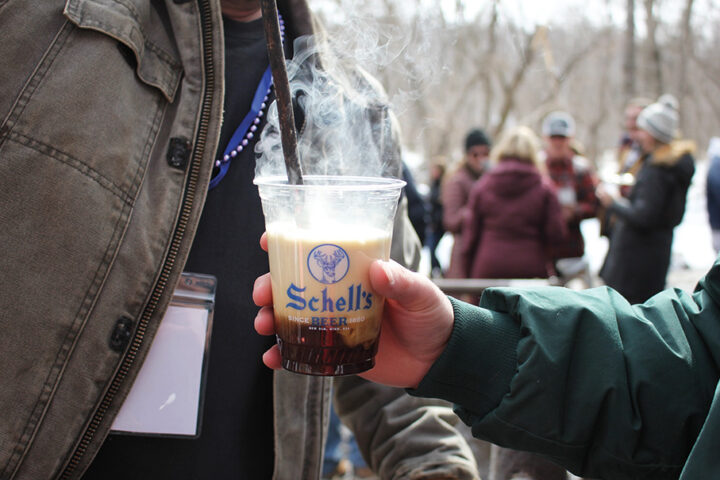
Beer poking—the centuries-old German tradition of heating a metal rod over an open flame and dipping it into a glass of beer during cold winter months—has become popular in some markets around the country. The process works to caramelize the malt in a beer, yielding a frothy, smoky character and roasted-marshmallow taste. “People love it,” says Jake Asheim, bartender at the Gnome Craft Pub in St. Paul, Minnesota. The venue allows guests to poke their beer year-round. “It’s a fun, shared experience,” Asheim says.
Kyle Marti, vice president at August Schell Brewing Co., in New Ulm, Minnesota—the second-oldest independent brewery in the country—is widely credited with reviving beer poking. “For those who have never experienced it, there’s a look of wonder,” he says.
For the past few winters, Pour Man’s Brewing in Ephrata, Pennsylvania has hosted novel—yet traditionally based— events that highlight the toasty attributes of some of its beers. Beer poking at the brewery has allowed Pour Man’s to stand out from the competition while offering a unique experience. “Beer poking hits all of the senses,” explains Ryan Foltz, co-owner and brewer. “It’s visual and creates a campfire-like smell. The poking subtly warms the beer and breaks up the carbonation, providing a marshmallow flavor.”
While Schell’s has hosted beer poking events in Minnesota for nearly 40 years, Marti, the sixth-generation descendent of founder August Schell, says the practice in the U.S. dates back to the brewery’s founding in 1860. “Germans like to drink their beer warm, and with the weather so cold in Minnesota during the winter, these immigrants began warming sticks and placing them in the beer to bring the temperature up.” Beer poking at Schell’s was revived in 1986 at the brewery’s annual Bockfest, which celebrates the release of its seasonal bock beer. Today, the one-day event in early March has grown to attract some 7,000 beer lovers, with the opportunity to poke their beers at bonfires being a particular highlight. Schell’s bock—with its intense maltiness—is an ideal brew for poking, Marti adds.
Beer poking trends are, indeed, seeing a resurgence. Pour Man’s, for example, began the practice in 2021 in an effort to educate its customers about historical beer trends, and it has grown in the years since. The Pennsylvania brewery now hosts several beer-poking events a year, including its annual Bockfest. To poke brews such as its rauchbier, the brewery features specially built burners on its backbar designed to heat up metal rods.
On-premise accounts, particularly in Minnesota, have also gotten behind beer poking, due in large part to Schell’s effort to spread the practice. Drafts Sports Bar & Grill in Crookston, Minnesota, has hosted poking events for a few years, according to owner Jasmine Melsa. “They’ve been really successful. It gets pretty cold here in northern Minnesota and we still draw a decent crowd, despite being outside in January,” she says. “It’s morphed into a bigger thing than we ever expected.” Local brews, such as bocks and others high in malt are typically used to create what the venue markets as “beer s’mores.”
Beer poking has seen such a revival at Minnesota’s Gnome Craft Pub that Asheim says many customers pay a $3 upcharge to do it. He notes that Gnome sells as many as 30 pokes a week. And with competition to attract beer lovers continually on the rise for brewers and bar operators, beer poking events provide a point of distinction. “Having good beer isn’t enough,” says Schell’s Marti.
Still, Marti and others note that beer-poking events can provide challenges. “You’re working with a firepit and wood and moving things around,” he explains. “With a red-hot steel poker, safety must be a consideration.” Foltz adds that with the need to keep the pokers continuously clean, beer-poking events can sometimes be labor intensive.
Still, supporters say that while beer poking may not be widespread in practice, it’s relevant. “It’s been a tradition at Schell’s for nearly 40 years,” says Marti. “It’s hardly a fad.” Asheim concurs. “Beer poking is a timeless tradition that’s here to stay,” he says.