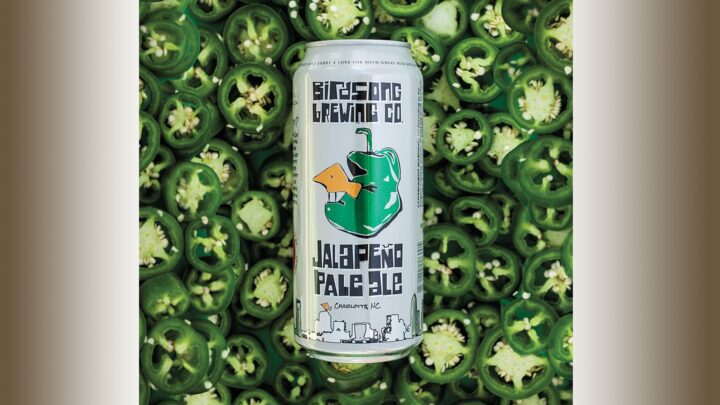
More than a decade ago, North Carolina’s Birdsong Brewing produced a one-off beer made with jalapeño peppers for its on-site bar. Response to the novelty brew was strong and it quickly sold out. “The next day, a customer came in and demanded it,” says Birdsong co-owner Chris Goulet. Ever since, Birdsong Jalapeño pale ale has been available on tap at the Charlotte brewery. In fact, up until a few years ago, it was the craft brewer’s top-selling beer.
While they’re certainly a unique beer style, spicy brews—whether steeped with fresh chilies or powdered peppers—have been well received by adventurous craft beer drinkers. Indeed, Goulet says beers that offer heat can be enjoyed every day, noting that there’s a surprising number of options. “They’re not as much of a novelty as you might think,” he adds.
In addition to the brewery’s taproom, Birdsong Jalapeño pale ale is available at retail accounts in North Carolina and South Carolina in 4-packs of 16-ounce cans ($12). For consumers who are unfamiliar with the label, the cans note that the brew has spice on the finish. “We didn’t want the taste to be heat,” Goulet explains. “The beer has a jalapeño aroma and a little heat on the finish.”
Birdsong isn’t the only brewery spicing up its offerings. In fact, spicy brews can range from pale ales to blonde ales to lagers and even sour beers. Lexington, Kentucky’s Country Boy Brewing first produced Nacho Bait Habanero blonde ale, a spinoff of its Cougar Bait blonde ale, in 2012, and according to marketing director Pete Weiss the brew’s heat profile has crept up over the years. “In early batches, we would strip all the seeds and veins from the habaneros [so that] the finished beer would have some heat, but you could also taste the underlying peach and mango flavors,” he explains. But over time, consumers became increasingly receptive to more heat so seeds and veins were incorporated. Nacho Bait is available at Country Boy’s four taprooms as well as retail accounts like Ohio’s Jungle Jim’s International Market. Additional Country Boy spicy brews include the seasonal Jalapeño smoked porter, which Weiss says isn’t as spicy as Nacho Bait, “but more of a balance between fresh jalapeño pepper, chocolate malt, and barbeque smoke flavors.”
The inspiration behind Tommyknocker Brewery & Pub’s Burro Verde lager, meanwhile, is a green chili stew popular in Colorado and Arizona. According to Lance Erickson, beer and marketing ambassador at the Idaho Springs, Colorado brewery, Burro Verde has been produced for at least a decade and is the result of a proprietary system that injects chilies into the brew batch, allowing for a “specific heat ratio and flavor profile.” While the beer does carry a little bit of heat, Erickson says, “it’s earthy, green, with a nearly cool blend,” and is surprisingly refreshing. Burro Verde is available for $11 a 6-pack of 12-ounce cans in the Denver area.
At Talea Beer Co., sour ales are often used as the base for both annual and limited-time spicy brews. Every spring, for example, Talea produces a different Spicy Marg, a spicy Margarita-inspired sour; this year’s variant featured pineapple notes and a “heavy hand of habaneros,” according to LeAnn Dorland, co-founder and co-CEO of the Brooklyn, New York-based brewery that has several taprooms across New York City. Haba Haba Splash sour ale, also brewed with habaneros, is released every June. Talea beers are distributed to some 2,000 on- and off-premise accounts around New York City.
Brewers note that spicy beers can be a great food companion. Burro Verde, for example, pairs well with Mexican food, southern barbeque, grilled chicken, and red meats, Erickson says. Goulet points to “anything savory,” as great accompaniments to Jalapeño pale ale, adding that a local restaurant incorporates the beer into a beer cheese that’s become popular.
But the brewers concede that spicy beers can be polarizing. “Sales can be hit or miss at retail,” Dorland notes. Another challenge is draft service, as fiery peppers can damage lines. Still, spicy brews appeal to consumers enamored with the heat. “People are so flavor-forward today,” says Dorland. “Spicy beers bring interest and entertainment.”