The U.S. imported wine category encountered another challenging year in 2025, with many leading brands losing volume amid a continued shift toward higher-priced wines. Total bottled imports into the U.S. declined 3.3% to 65.77 million cases last year, according to Impact Databank. That marks a continued slide from the category’s high-water mark of 79 million cases in 2017, with only a brief rebound in 2021 and 2022 interrupting a broader downward trend.
The ongoing pressure on volume reflects more than short-term market swings. Importers are navigating a mix of headwinds—from increased tariffs to evolving consumer preferences, particularly among younger drinkers who are consuming less wine overall or shifting to alternative categories. Together, those forces are reshaping demand and accelerating a move away from high-volume, value-driven brands toward wines in the $15-$25 bracket.
Italy remains the dominant player in the U.S. imported wine market, totaling 22.67 million cases despite a 2.2% decline last year—still nearly 9 million cases ahead of second-ranked France. French imports held relatively steady, edging up 0.7% to 13.72 million cases, as they continue to lead on a value basis. Although French wines saw a 9.7% drop in shipment value in 2025, they still generated more than $1.3 billion, demonstrating strength at higher price points. Italy, ranking second in value, declined 12.5% to just under $1.2 billion.
New Zealand remains a bright spot, buoyed by continued demand for Marlborough Sauvignon Blanc. Kiwi shipments rose 7% to just under 7 million cases, with shipment value at roughly $470 million despite an 8.7% dip. And while most leading imported wine brands posted losses in 2025, New Zealand defied the trend, led by gains from Whitehaven ($17 a 750-ml.), which increased 12%, and Matua ($12), which grew 5%.
Australia was among the most challenged segments in the imported wine category last year, with volume falling 15.6% to 5.48 million cases—a steep drop from its 2005 peak of 18.89 million cases in the U.S. market. Other Southern Hemisphere producers also struggled, with Chile, Argentina, and South Africa posting notable declines. As the U.S. market continues shifting toward higher-priced wines, leading brands within these value-oriented segments are losing ground, with a shrinking presence among the top 20 imported brands in the U.S.
But opportunities remain for imported wines despite the volume pressure. Demand for higher-priced, origin-driven wines remains resilient, with New Zealand gaining traction and premium European producers maintaining strong appeal. Importers are also adapting—refining portfolios, focusing on brand differentiation, and aligning with evolving consumer preferences. While an unpredictable tariff environment in 2025 weighed heavily on the category, the outlook has stabilized this year, giving importers greater clarity to reset pricing and move forward. “I feel the issue we faced last year was uncertainty, and when the market is uncertain, it’s almost as if everyone is frozen in time,” says Adam Sager, co-president of Winesellers, Ltd., which boasts a robust import portfolio led by European labels. “Now we know what we have, and we can move forward and find opportunities to expand points of distribution.”
European Wines Lead
Italian wines continue to hold a strong position among the top 20 imported table wine brands, with nine entries on the list. Category leaders Stella Rosa, from Riboli Family Wine Estates, and Cavit, from Palm Bay International, held their No.-2 and No.-3 rankings, respectively, despite volume declines. Stella Rosa ($12 a 750-ml.) slipped 7.5% to 3.75 million cases, yet it remains one of the largest wine brands in the U.S. Cavit ($16 a 1.5-liter), at 3.5 million cases, also commands a dominant position in the category.
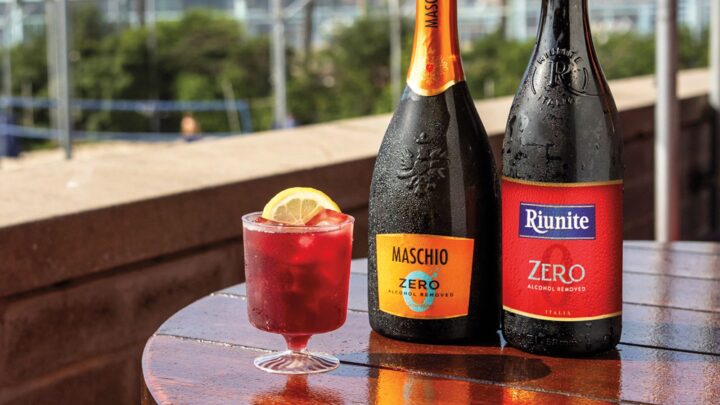
Riunite ($7 a 750-ml.), ranked ninth among top imported brands, dropped below 1 million cases in 2025, declining 9.5% to 920,000 cases. Its importer, Frederick Wildman & Sons, maintains a broad Italian portfolio that includes Santi, La Selvanella, Re Manfredi, Tenuta Rapitala, Marchesi di Barolo, Le Chiuse, Fattoria dei Barbi, and Castello Monaci, among others. The company also expanded into non-alcoholic wines last year with Riunite Zero Red Semi-Sparkling ($10) and Maschio Zero White Sparkling ($13), a Prosecco-style alternative.
“Our premium and ultra-premium categories are not experiencing the headwinds that more value-proposition brands are feeling,” says Matt Munn, president and COO of Frederick Wildman & Sons, which handles Riunite in the U.S. “The above-$20 category is pretty resilient at this point. That consumer hasn’t changed their consumption habits. But we’re feeling it more at the value level where there’s a lot of choice for the consumer at those price points.” Munn notes that aromatic whites and sparkling wines continue to perform well, and points to opportunities in alternative packaging—particularly smaller formats that offer greater convenience and flexibility for consumers.
Illinois-based importer and marketer Winesellers highlights continued momentum for bright, crisp, aromatic, and affordably priced white wines. The company points to its Italian portfolio to match, which includes Tuscany’s Piccini Orvieto Classico ($11 a 750-ml.)—an organic white wine that has performed well and is part of the core set at Whole Foods, averaging about 5,000 cases in annual sales.
Winesellers’ French portfolio is also showing strength across key segments. “We’re seeing $12 French rosé growing; our brand Mont Gravet is performing very well in the difficult market,” says Sager. “It overdelivers for quality-to-price, and increases in Provence rosé have forced consumers to seek more affordable alternatives.”
In February, Winesellers reunited with Les Vins Georges Duboeuf, one of the most recognized French wine brands in the U.S., after previously representing the label for two decades. Early response has been strong, particularly to the Flower varietal line ($16 a 750-ml.), which offers unoaked, fruit-forward wines—currently Sauvignon Blanc, Chardonnay, Merlot, Pinot Noir, and Cabernet Sauvignon—aligned with by-the-glass demand in on-premise channels.
“Beaujolais Crus are terrific values when compared to Burgundy, and Duboeuf has a full portfolio of wines that are fruit-forward, lower in alcohol, and can be served slightly chilled,” notes Sager. “And lastly, Sancerre sells pretty much at any price point.” Winesellers has also partnered with a local producer to launch its proprietary Sager & Verdier Sancerre, which sells roughly 10,000 cases annually, primarily on-premise, with strong markets including New England, the Mid-Atlantic, California, Colorado, and Illinois.
La Vieille Ferme ($8 a 750-ml.) and Chateau d’Esclans Whispering Angel ($20) led the French category by volume last year, with La Vieille Ferme delivering the strongest growth among the top 20 imported brands, according to Impact Databank. The Perrin family-produced label, imported by Vineyard Brands, jumped 15.8% to 810,000 cases in 2025—adding roughly 150,000 cases over the past two years despite challenging market conditions. Positioned in the sub-$15 segment, it continues to resonate as a reliable value option.
“La Vieille Ferme has always represented a gateway wine for Americans looking to enjoy European wine drinking culture—light, fresh, balanced, and to be enjoyed with meals,” says Catherine Cutier, senior vice president of marketing and brand strategy at Vineyard Brands, which imports the brand. “This is particularly resonant at this time when consumers are looking for lighter options and focusing more on health and lifestyle as opposed to simply consumption.”
While rosé has been a key growth driver, the brand’s red and white offerings remain popular. The company is also exploring new packaging formats to meet evolving consumer preferences, including magnums, bag-in-box, and cans.
In France’s Languedoc region, Gérard Bertrand maintains a strong position in rosé with wines such as Cote des Roses, Gris Blanc, and Clos du Temple, while looking to expand its presence in white, red, and sparkling wines in the U.S., along with niche segments like orange wines. Gérard Betrand’s portfolio was at 528,000 cases in the U.S. in 2025, according to Impact Databank.
“Our ambition is to accelerate trends for the other wines in our portfolio in addition to rosé, because that’s only one-third of our production,” Bertrand says. “We’re also leaders in biodynamic farming, organic, and no-added- sulfite wines, and orange wines, and we want to really share the full DNA of the company as we look to the future.” The Narbonne, France-based company is focusing on comprehensive marketing strategies this year and sees improving overall conditions for imported wine in 2026.
Southern Hemisphere Standouts
The imported category’s longtime volume leader, Australia’s Yellow Tail, posted another year of declines in 2025, falling 8.5% to 4.8 million cases, according to Impact Databank. Now roughly 2.24 million cases below its 2020 numbers, the brand’s lead has narrowed—sitting about 1 million cases ahead of second-ranked Stella Rosa.
Yellow Tail’s challenges reflect broader pressures facing the Australian category, which declined 15.6% in volume to 5.48 million cases and 11.3% in value to $193.1 million in the U.S. in 2025. Despite these setbacks, Australia remains the fourth- largest imported wine origin by both volume and value.
Wine Australia is investing in a multi-year marketing effort aimed at reigniting U.S. consumer interest. The campaign includes expanded event formats and outreach in new markets such as Minneapolis; Boston; Nashville, Tennessee; Charleston, South Carolina; Tampa, Florida; and Austin, Texas. With white and sparkling wines outperforming reds, the initiative will emphasize food pairings tailored to local markets—such as oysters and crab cakes in Boston and Hmong cuisine in Minneapolis—to broaden perceptions of Australian wine beyond its traditional associations with bold reds and value labels.
“The quality and diversity of our wines, the breadth of varieties grown across 65 wine regions, and the playful experimentation of our growers and makers ensure there is an Australian wine for every palate,” says Aaron Ridgway, regional general manager for the Americas for Wine Australia. And while Australia is facing the same headwinds as the broader category, it also has significant market share in some of the toughest price segments as well. “Our industry’s adaptability and willingness to give anything a go puts us in a good position to evolve the offerings in the U.S. to meet consumers where they are,” he adds.
New Zealand wines continue to show resilience. The third-largest imported segment grew 7% in volume to just under 7 million cases in 2025, though value declined 8.7% to $470.1 million. Within the top 20 imported brands, New Zealand labels posted strong gains, with Whitehaven from Gallo rising 12% to 1 million cases and Matua from Treasury Wine Estates increasing 5% to 870,000 cases last year, according to Impact Databank.
Other Southern Hemisphere regions, including Chile and Argentina, remain under pressure. Chilean wines declined 7.5% in volume to 4.08 million cases, while Argentina fell 7.3% to 3.57 million cases in 2025. Both segments are also facing value challenges, with average case prices below levels seen a decade ago.
Chile’s Concha y Toro, the fourth-ranked imported brand, declined 6.8% to 1.8 million cases in the U.S. last year, following a strong 2024 performance of 1.93 million cases. While the parent company’s premium offerings gained traction globally, lower-priced wines weighed on overall results. Premium- and-above products accounted for 57% of Viña Concha y Toro’s sales last year, with growth across key labels including Casillero del Diablo, which grew 2.5%; Diablo, which increased 15%; Don Melchor, which leaped 85%; Trivento, which grew 4%; and Bonterra, which also increased 4%. In the U.S., inventory adjustments, currency pressure, and double-digit declines in mass-market wines contributed to the company’s fourth-quarter drop, partially offset by growth in higher-end segments. Concha y Toro is now carving out its Viña Amelia brand as a standalone offering in upscale Pinot Noir and Chardonnay, similar to Don Melchor with its focus on Cabernet Savignon.
Within Winesellers’ Southern Hemisphere portfolio, Argentina provides pockets of strength, particularly Santa Julia and Zuccardi from Familia Zuccardi in Mendoza. Sebastian Zuccardi has developed a new winery focused on no-sulfite-added natural wines from organically grown grapes. At the ultra-premium level, Zuccardi’s single-vineyard wines are performing well.
While volume pressure remains, particularly at the value end, demand for premium, differentiated, and origin-driven wines continues to hold. For importers and producers, the next chapter will hinge on aligning portfolios with shifting consumer preferences.